
Project management sounds rather intimidating. First of all, there are so many types of project management: Waterfall, Agile, a Hybrid of the two, Design Thinking, Kanban…the list goes on and on. These styles of project management are used by designers to outline what needs to get done and by who in order to reach goals for their products in a set amount of time, considering all constraints and possible setbacks.
According to the Wikipedia article on project management, while there are many types of project management approaches, successful ones typically focus on these four main aspects: the plan, process, people, and power in a given project. It is important to have a clear idea of what resources are available to you and how you should allocate all of your resources to be the most effective it can be.
With those aspects in mind, a project continues on to begin its process groups: initiation, planning, executing, monitoring, and closing. In initiation, the scope, costs, and schedule must be defined.
According to the video Project Planning Process: 5 Steps To Project Management Planning the planning process itself is broken down into five steps: creating the plan (they suggest using templates) to mobilize the project, breaking down deliverables and receiving as much input as possible about them, determining dependencies and potential risks/issues, creating a solid timeline, and assigning resources to the project.
In executing, you simply follow the plan that was constructed in the last step. At the same time, you are monitoring and controlling the project – you should be asking “where we are”, “where we should be”, and “how we can get on track again” then implementing what resources you can to improve the process.
Now that the project management process itself is a bit less intimidating, how can I apply this to my life as a student? The farthest I have gone in “managing” my deliverables is by using myHomework. While it has proven to work for me in the past (all the way back to freshman year of high school), my projects are becoming more complex and include multiple steps that need something a bit more visual and organized than a simple list.

As my projects are growing, I am in need of a program that goes beyond “incomplete” and “complete”. I needed to explore more applications that make sense for me to use as a graduate student and a filmmaker. I decided to go with Trello as it allows me to meet all of my organizational needs – I can create boards for each subject, change the lists to match the needs of each project, and create sub-lists for multi-step projects.
For more linear projects, I chose to go with the Kanban method for my lists: To-do, Doing, and Done. As you can see I also added “long-term to-do” for things that are longer-term goals and a list for my weekly tutoring sessions. Since it is so easy to create the cards, I went through my syllabus and added the rest of the assignments for the semester to the “To-Do” list- I will simply drag the cards over to “Doing” once they are assigned in class.
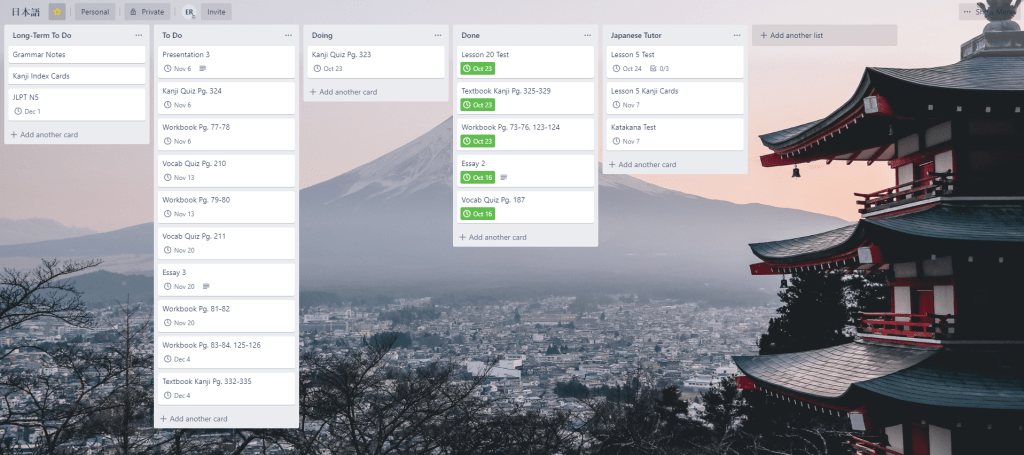
What is wonderful about Trello’s versatility is that it also suits my needs for film projects. In Matt Jacobs’ article How To Use Trello for Video Production Project Management he highlights Trello’s collaboration feature and explains how to use tags to assign each task to a specific person. It is also useful that you can set deadlines for specific tasks – deadlines are important in filmmaking and there are many to keep track of.

In Jacobs’ article, he talks about how editor Zach Arnold (known for his work on Glee and Burn Notice) converted to Trello from his old method of using index cards and post-it notes for his projects. Arnold uses Trello to its full potential by adding members, paperwork, a workflow checklist, and due dates to each task.

I even shared my Trello board with the other members in my group. Even though we meet twice a week, there is always someone asking for clarification about a due date or who is doing what or where a specific document is. Now, we simply have to remind each other to check the Trello board.
While I have found project management to be very useful in my school and work life, I felt like I was lacking in the project I am constantly trying to work on: myself. After viewing the video Work Smarter Not Harder, I realized that I need to focus more on the “why?”: I need to define the results I want from doing everything I do in order to improve not only my quality of work, but my life balance.

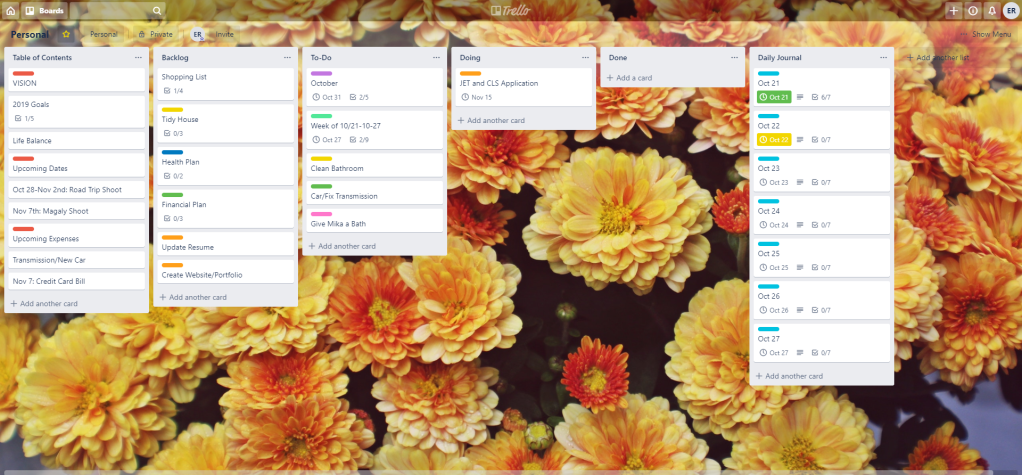
My first “Personal” Trello board looked like this. I thought it would be best to separate my lists by each aspect of my life that I wanted to improve upon. However, it somehow ended up looking bleak and overwhelming at the same time.
Then I read Britt Joiner’s article How To Build A Daily Habit Tracker In Trello (And Reach Those Goals!) and sympathized with her statement that she found herself on “auto-pilot” to complete tasks rather than working on long-term goals. She said that to remedy this, instead of simply listing projects, she “builds systems and habits that would hold [her] accountable to my goals along the way.”
She references James Clear’s idea that rather than focusing on your goals, you should focus on the systems you use to reach them. In Clear’s article Forget About Setting Goals. Focus on This Instead. he outlines the four main problems with goal-centered thinking.
First of all, he says that winners and losers share the same goal – it is only the winners who went beyond having a goal by implementing a system to reach it. The second problem is that achieving a goal is only a momentary change. If one instead focused on fixing problems at a “systems-level”, the outcome will automatically improve.
“Fix the inputs and the outputs will fix themselves.”
Clear, J. (2018, October 16). Forget about setting goals, focus on this instead. Rockyhouse
Publishing. Retrieved from https://jamesclear.com/goals-systems
The third problem is that by setting a goal you are restricting your happiness, or rather you are saving your happiness for your future self who completed that goal. To solve this, we must not look at the binary system of goals (either reaching it or not) and focus on the system we can make to better ourselves.
The final problem with goals is that they are contradictory to long-term progress, since when we reach a goal we typically stop doing the good habits that lead to its achievement. Clear argues that our aim should be to “continue playing the game rather than winning it.”
With system-centered thinking in mind, I set out to follow Britt Joiner’s template for a habit tracker that would not only help me reach my goals, but improve my happiness for my present self.
First she suggests setting the building blocks by creating a table of contents with the overall vision and themes for the year, upcoming dates, and upcoming expenses. This is an at-a-glance reminder of why I am doing these daily habits.

Next, she suggests mapping out goals and projects with the “backlog”. However, since balance is the real goal, theses projects must be a priority or fit into the yearly goals.
Then she says we can “make the magic happen” in our “To-Do” list. She suggested creating a monthly and weekly card for the habits you want to keep repeating. The monthly list should include small actions that lead to larger goals and the weekly tasks should be smaller habits that you can look at and get done in a few minutes.


Finally, there is the “Daily Journal” list to promote creating the right daily habits. This list has a card for each day that includes a daily journal, some quick check-in questions (I chose mood, thankful, and look forward to), and a daily checklist.
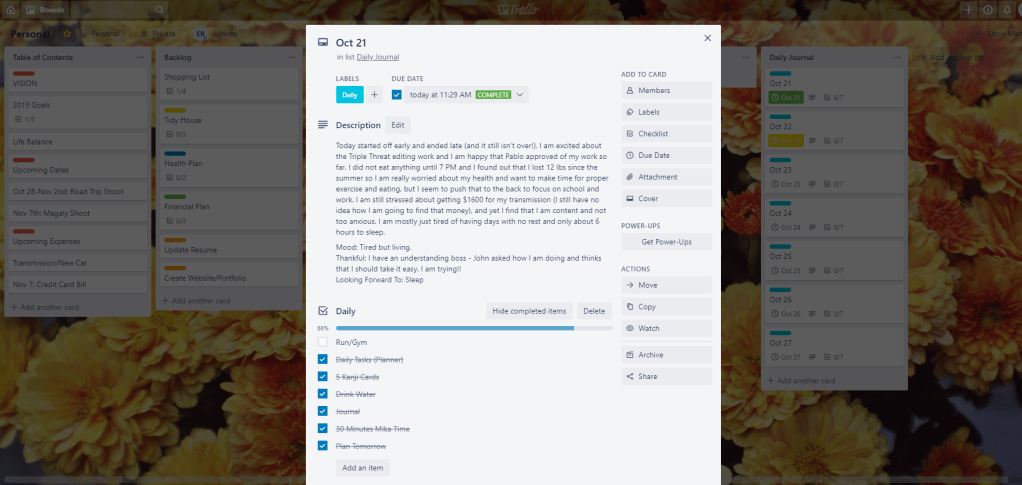
I hope to create a similar board for my work life once I begin a daily office job following the habits suggested in the video 7 Work Habits You Need to Succeed – Project Management Training. For now, though, I need to hold myself accountable to improve my health and decrease my stress. By mobilizing my project plan to improve myself, I think I am heading in the right direction.
 Emma Lao
4 responses to “Project Management: Planning for Habits, not Goals”
I found your discussion on goal-oriented thinking pretty interesting. I’ve always found goal-oriented thinking difficult as I’ve had the same struggles as you mentioned, in that it’s only a momentary change that doesn’t last. It makes it feel like the goalpost keeps moving but you never reach it. I also find all the different boards you’ve done impressive. I personally feel like I would become quickly overwhelmed with all those different boards, but you but everyone is different I guess.
LikeLike
[…] “Immerse Yourself in Industry-Related Materials.” Derek Robinson strays a bit from boredom by using his commute to get up-to-date on what is going on in your industry through podcasts, webinars, or audio books. While this is not quite what Newport had in mind for “embracing boredom,” it is useful for people like me who have very little time to explore these topics otherwise. Some of the audio books I have listened to were not necessarily industry-related, but work on some of the long-term goals and habits I have in mind for myself. Marie Kondo’s The Life Changing Magic of Tidying Up and Dave Ramsey’s The Total Money Makeover have already made an impact on my daily habits – something I argue you should focus on in another post. […]
LikeLike
[…] choosing the two writing pieces for this assignment, sources I used in my own blog post about project management immediately came to mind. Why? Because they are fundamentally the same, […]
LikeLike
[…] where you can plan exactly how you spend all of your time. While in my whitepaper I suggested using Trello, I have since moved to a physical planner, namely the Hobonichi […]
LikeLike