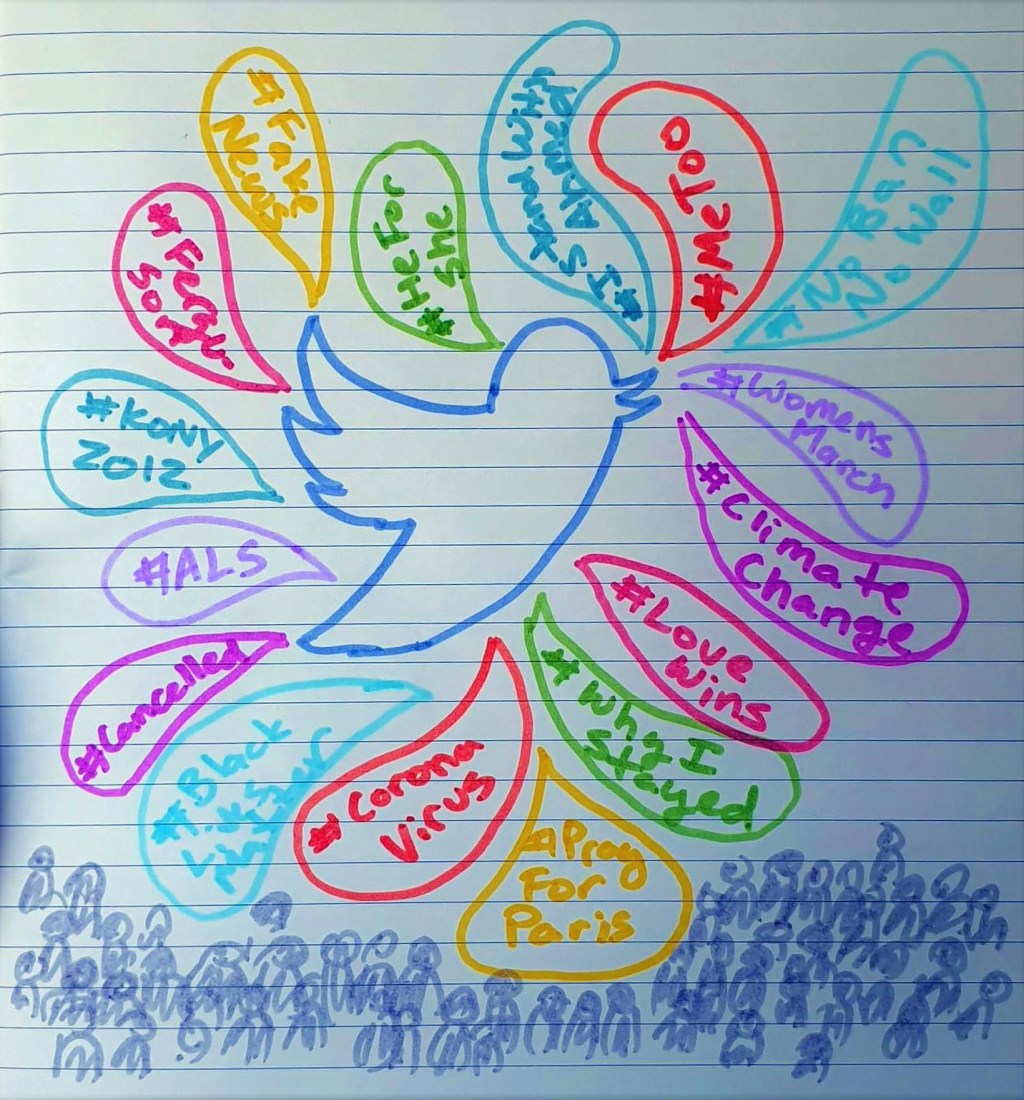
Historically, media allowed organizations to spread one message to a mass of people without their voice being heard. The only time the individual was able to participate in media was with other individuals via telegrams or telephones. Until recently, it was difficult for people to share their stories others using media and impossible for communities to collate.
With the emergence of social media, the audience’s role was morphed into an active role of both a consumer and a producer. In Clay Shirky’s TED Talk “How Social Media Can Make History”, he delves into the fact that modern media allows for individuals to convene and support each other as a group. Conversation can now take place between consumers, allowing for information to be transmitted from individual to individual rather than individual (or organization) to a mass of people.
This conversation has allowed people to create groups to support each other and do good. The #MeToo movement is an instance of people using social media to come together and make a stand against their abusers. This movement began all the way back in 2006 when activist Tarana Burke coined the phrase for use on MySpace as a way to help girls share their stories of being sexually assaulted. The movement did not become popular until 2017 when the actress Ashley Judd was the first to accuse Harvey Weinstein of sexual assault. Since then more and more people began to speak out about their abuse and Weinstein is in prison. The Chicago Tribune has a timeline with a list of articles pertaining to the many cases of justice done to those who have only recently been held accountable for their actions thanks to online communication and support.
However, there have been many instances of the group mentality affecting people negatively. One of the most debated fads in social media has been the idea of “cancel culture” where hordes of people declare a person is “cancelled” due to something they said or did in the past. While it is important to keep people accountable for their actions, many have argued that “cancel culture” has gone too far.
Celebrities are often the target for “cancellation”. Unlike the #MeToo movement, though, the things that get these public figures in trouble are things that were done publicly in their past that were typically socially accepted at the time. Celebrities will often lose opportunities or their livelihoods due to the pressure put on their employers to fire them by the people on social media declaring them to be unworthy.
There are countless instances of this happening, one of which was James Gunn losing his position as the director in the Guardians of the Galaxy series after insensitive and offensive tweets that were meant to be humorous from about ten years ago re-surfaced. Gunn did not deny his past, but was disappointed with how he was punished for it despite being a different person now, saying in a tweet from July 20, 2018, “I used to make a lot of offensive jokes. I don’t anymore. I don’t blame my past self for this, but I like myself more and feel like a more full human being and creator today.”
Cancel culture has even become a part of teen’s social interactions with each other. One teenager shared her story of being “cancelled” by her peers when she was 15 years old without even knowing why in the New York Times article Tales From the Teenage Cancel Culture. She said that “You can do something stupid when you’re 15, say one thing and 10 years later that shapes how people perceive you. We all do cringey things and make dumb mistakes and whatever. But social media’s existence has brought that into a place where people can take something you did back then and make it who you are now.”
Another negative effect of the group mindset and discourse that social media has paved the way for is the sharing of political misinformation and distress. In the article The Political Environment on Social Media by Aaron Smith he shares data by the PEW Research Center found that both democrats and republicans see the much of the tone of political discourse on social media as “uniquely angry and disrespectful.” They also found that 37% of social media users are worn out by the amount of political posts and that 59% of the political discourse with opposing party members are stressful and frustrating. On top of that, literally anyone can share their opinion or write an article, as Shirky notes, there are more and more amateurs creating online content and less and less professionals having their voices heard.
I believe that there is so much potential to do good with the tools that are available to us – especially now when people are forced to be separate, online communities allow us to stay connected with humanity. There are already countless examples of people coming together to take action and make change for the better via social media. However, people should be aware of how groupthink that the potential to negatively shape their views, mood, and actions. As long as people use the internet with caution and understand that very little of what is online is said by professionals, then it is a wonderful tool to enhance our connections with each other and even change the world.
 Emma Lao