SpaceX partnered with NASA to send two astronauts to the space station on May 27th, 202. There were four main events within this SpaceX Launch that news sites covered on social media. First was the hype about the announcement of the upcoming launch date at the beginning of the week.
The social media response was mostly positive and the most popular articles were credible and factual. Then on May 27th the launch was postponed due to bad weather conditions.

This is when political posts began to appear, something that was not common beforehand.
The next day, people began to poke fun at the situation as they prepared for the new date.

Then on Friday, May 29 a SpaceX prototype rocket exploded at a Texas launch space. Even though the rocket was a completely different model than the one going to space the next day, the timing was just right to make people alarmed about the safety of the astronauts and brought up political issues with SpaceX.
There were still some credible journalists who approached the situation with only facts.
There were also many articles being circulated on Facebook. One thing to note is that by far the most shared article was one from TMZ which was published only 34 minutes after the explosion. The rest of the articles that followed were much less popular even when the page had more followers.
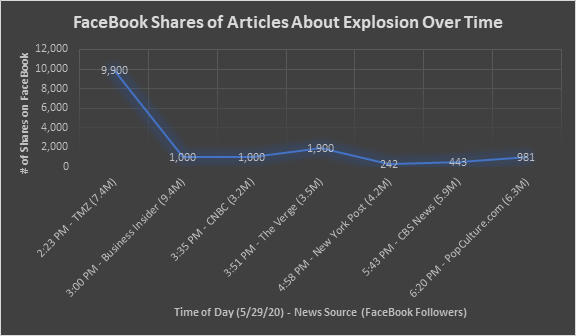
This phenomenon is something that is not new to social media – journalists are forced to act fast or miss out on a huge opportunity. In Ryan Morris’ case study on breaking news in social media he found that a similar article from two sources with a following about equal to each other had a difference of 360 vs 197 shares just because one posted nine minutes earlier. The next big news outlet to cover the explosion after TMZ was Business Insider, and even though they have 2 million more followers on Facebook, they had 8,900 less shares.
The Business Insider article was through, factual, and clear while the TMZ article itself had no mention of sources and was mostly speculation. It also had a misleading title that would lead people who only read the headline to believe the rocket that exploded could be the one that was supposed to carry the astronauts to the space station on Saturday – there is no clarification in the article for those who are not well-informed about the launch that it is a different rocket. This especially troubling since according to Nicole Martin’s article “How Social Media Has Changed How We Consume News” the average read time of online content is 15 seconds. Meanwhile, Business Insider laid out all of the facts right at the top of their article in a quick and easy-to-read format which can easily be understood in 15 seconds. Still, the TMZ article was first and therefore the most shared.
Finally on Saturday, May 30th the Crew Dragon successfully launched and the coverage was mostly factual and positive again. The launch was also the only non-political and positive trend on Twitter.

It is interesting to see how when everything was going according to plan the popular articles were considerably more credible than the ones that happened during the chaos of the explosion. When the explosion happened posts were much more opinion-based, emotional, and full of speculation.
The immediacy of social media can be to blame for the lack of facts and amount of rumors in some of the articles that were posted in response to the explosion. However, social media also had a positive effect on the story by sharing live footage of the launch – an event that many people were excited to tune into.

Facebook had more posts of information about the launch and where to watch live while Twitter had more posts of people’s reactions to the event. It was also a lot easier to find opinionated and political posts about the launch on Twitter – many were even liked and retweeted quite a bit. It was difficult for me to find those kinds of posts on Facebook since my personal circle does not make posts like that.
I feel that the best way to learn about the launch is to read articles from trusted sources and follow official Twitter accounts like @SpaceX and @NASA for direct real-time information. When it comes to some events that are unexpected like the explosion, it is best to wait for a trusted news site to make an article rather than feed into the immediate rumors and speculation.
While I am not typically a user of Twitter, it was interesting to follow the event’s updates in real time. However, the moment I opened Twitter for the project I would become distracted by the opinions of people who I frankly do not care about – so in the future if I do decide to use Twitter again I will be sure to follow only those that I want to hear from. I may even use an app like Stay Focused to be sure that I use the site only for what I intend to so that I cannot mindlessly scroll for hours.
A final takeaway from this case study was how when something goes wrong people news sources are quick to jump onto the story and people are quick to use the failure as a way to spread negativity. Still, it was heartening to see the Tweets made by the majority of people who were excited for the country’s next step in space exploration.
 Emma Lao