Search Engine Optimization is referenced non-stop when doing research about creating a web page – and for a good reason. Having good SEO means more people will see your page, which means more traffic, which means reaching your goals! The best thing about SEO is the fact that it is a completely free method of gaining traffic – but it requires you understand at least the basics.
Moz Pro’s Beginner’s Guide to SEO is a great resource if you are looking to get a full understanding of how to start, but I will summarize the most vital points you should know in this post.
SEO Basics
Before jumping into how to improve SEO, you need to understand some basic principles and lingo.
Having an optimal SEO means you can gain much more organic search results, meaning you do not have to pay to be seen. Instead, you have to follow guidelines that align with how each search engine decides what gets to be seen.
There are two techniques – “white hat SEO” and “black hat SEO”. White hat SEO is used when a website follows the guidelines as they were meant to be followed in the hope to provide value to a user. Black hat SEO is used by websites to try to trick search engines into bringing it to the top without adding value. This is risky (and a bit unethical) and it can severely penalize your search engine ranking if it is detected.
When carrying out SEO, the most important thing to have in mind is aligning your site with the user’s intent. When creating the title, metadata, keywords, and of course content it should all be the type of content the user is actually looking for.
Before you can know the user’s goals, however, you need to know what your goals are for your website. It is best to outline a Key Performance Indicator (KPI) so that you have a clear and actionable goal. If you want to raise your traffic it has to be for a reason, so outline that reason clearly and check to make sure that everything you are doing is helping you reach that goal as you go along.
The Seven Steps
No matter the KPI, having more traffic and a better ranking will help you reach that goal. There are seven steps that you can take to get better ranking in search engines, as outlined by Moz Pro:

1: Establish Crawling, Indexing, and Ranking
In order for your page to be seen on search engines, it needs to be accessible to “crawlers” that can index the content and rank it to how relevant it is for a search. See Google’s more in-depth explanation here.
To start, see how many indexed pages from your site are already accessible to search engines by typing in “site:yourdomain.com”. If nothing appears, it may be because your site is too new, isn’t linked from an external site, is using black hat methods, or the navigation is too complicated.
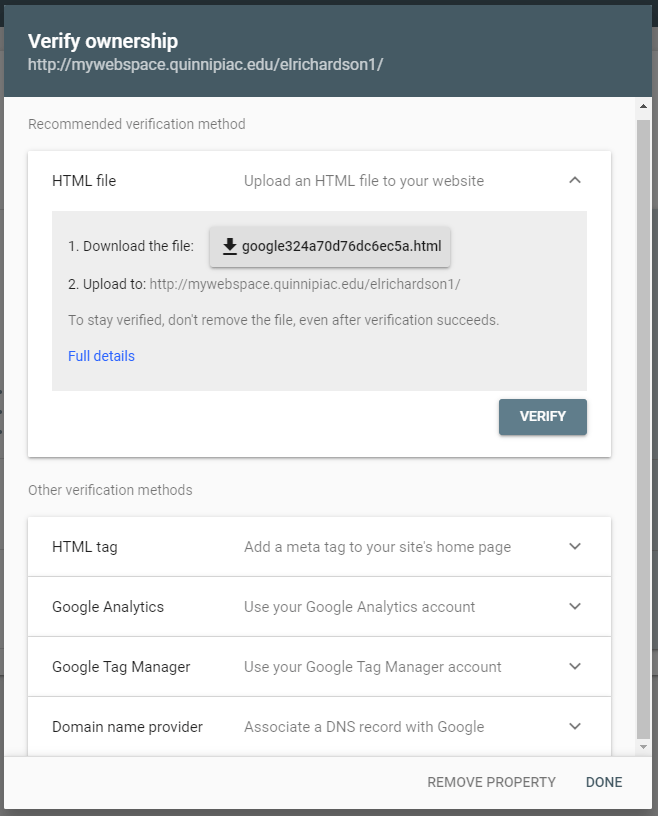
To understand your index coverage better, Moz Pro suggests signing up for Google Search Console. Verifying the ownership of your site is as easy as downloading the file and using a FTP to upload it to your site.
Once you ensure that your site is visible to search engines, it is time to make it easy for crawlers to navigate and know what information is important.
For unimportant information that would hurt the ranking you should use a robots.txt file. These allow or disallow certain pages to be seen by crawlers.
To have crawlers easily access your content that you want to be seen there are several things you can do:
- Don’t hide text you want seen in non-text content – if you need to have content in the form of images, videos, ect. try to put it in text within your code as well.
- Make sure your site has clear navigation.
- Test for errors that the crawlers could be encountering by using the Google Search Console’s Crawl Errors page.
2: Create Compelling Content
Once crawlers find and index the content on your site, they make a ranking. It is not 100% clear what it is based on, but it is known that a few factors contribute to a better SEO:
- Links to the site and the quality of them.
- Engagement metrics like clicks, time on page, and bounce rate.
- The content on your page.
Of course, those three factors go hand-in-hand – the better the content, the better the metrics, the more credible sites will link to yours. Avoid using “thin” content that is there for the sake of just existing; you should be sure that each page is there for a reason and it actually adds value.
3: Use the Right Keywords
The first step to knowing what keywords a user will type to find what they are looking for is to know who they are in the first place. One route to doing this is to create a persona of the user. To go more in-depth about your specific site, ask all of the questions pertaining to it that you can.
Next, list all of the possible keywords that you can. Using a keyword research tool is very useful since it points out many suggestions and the volume of each keyword. For example, if I wanted to make a website displaying my photography portfolio or promoting a photography business, I cold see what keywords are getting the most volume. Of course, only add the keywords that are actually relevant to your page or you risk having a worse page bounce metric.
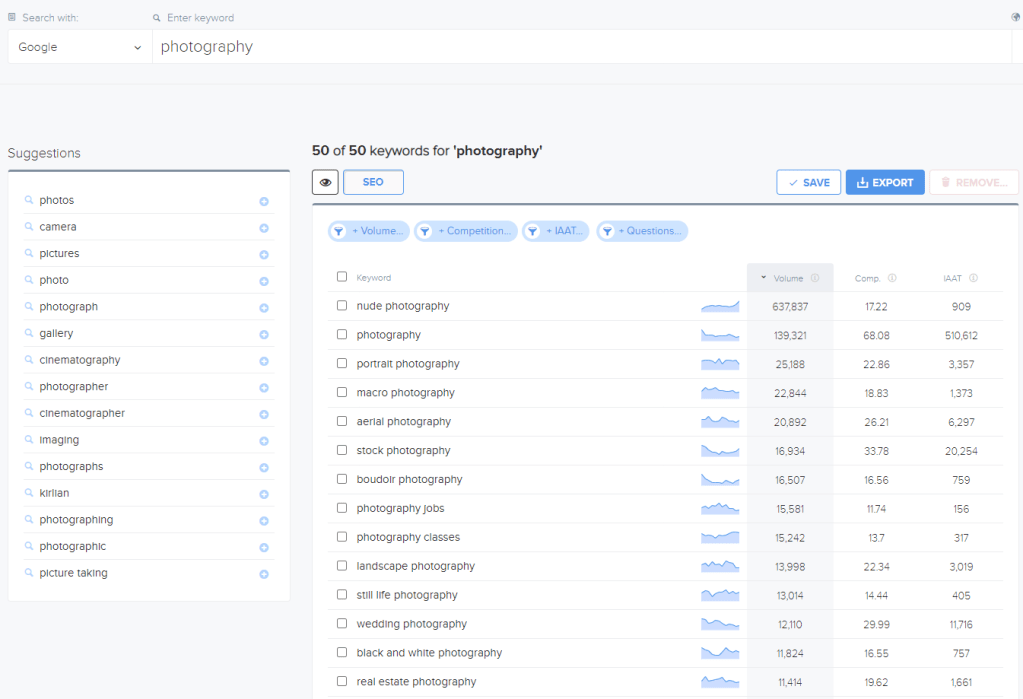
Try to include keywords that your competitors are not using (you can see the competition metric in the image above) so that you are more likely to be seen. Also, update your keywords to match the time of year and your location – a good way to see the metrics for this is Google Trends.

Avoid “keyword stuffing” though – as Moz Pro says “If a page is going to be valuable to users, it won’t sound like it was written by a robot, so incorporate your keywords and phrases naturally in a way that is understandable to your readers.”
4: Improve Your User Experience
To make sure that your page is valuable to its users, the experience of using it must also be good. Make sure that images are optimized and that they have alt text – bots will be able to better understand what the image is trying to convey. Check out more of my posts on adding functionality to your page to make a better UX design.
5: Create Share-Worthy Content
Earlier this Summer I made a series of blog posts on creating quality content on the web and before that I made posts on how to write for the web. If you want your page to grow, read those posts to get started.
As mentioned before, links are an important aspect of SEO. As your page grows and you create quality content other sites will be linking to yours naturally, but there is more you can do to optimize your links. Read more about the specifics of links here.
6: Have an Accurate Title, URL, and Description
Within the HTML code you should be taking advantage of the header tags and title tag. As a quick reminder the header tags are in the <body> of the code and will be seen on your page, while the title tag is in the within the <head> and will be what appears in the search result. As suggested by Moz Pro, a title tag should use the optimal keywords, be under 60 characters, and include the name of your brand if possible.
Meta descriptions are also an important part of your <head> – while they do not appear on your page, they show up under your title in a search result. Not only do they help people searching understand what your page is, but they help the bots understand too.
URLs should be as clean-looking and easy to follow as possible since, according to Moz Pro, they will be “easier to copy and paste and more clickable”.
7: Make Your Website More Bot-Accessible with Schema
By adding structured markup to your page’s code will make it much easier for bots to understand what the content is about and therefore make your page more relevant to the proper searches. While I will not go more in-depth about how to markup your code, see this guide for how to implement the preferred markup type.
And with that you now know the basic components of optimal SEO. Each of these aspects should be considered as you plan out and create your page so that all of your hard work can actually be seen by your target audience. Follow my blog to see the next post where I create a portfolio using all of the knowledge I have learned this semester!
 Emma Lao