It is not new knowledge to most that images are able to be easily altered. When in the hands of people with the wrong intent, visuals have just as much power to do bad by misleading or blatantly lying to an audience. Below I explore five practices of visual storytelling that are unjust.
Misrepresentation of the Human Body. With the arrival of Photoshop (and now hundreds of filters and apps) came the altering of humans, mostly women. And with that came the expectations that you should look like these altered people in real life. For several instances of this see CNET’s article.
Staging “News” Photos. In a very concerning survey done by the New York Times it was found that more than half of the news photographers surveyed said that they sometimes stage photos and 12% that say they stage photos half of the time. This only adds to the mistrust of the media and goes against the code of conduct for most of the news agencies that these photographers work for.
Altering Elements of a Photo Without Disclosure. Alterations to photos are often innocent and do not change the meaning or intent behind it. However, in some cases it can change the entire photo. In the case of the photo shared by BP of their oil spill cleanup the color correction made the water seem much cleaner than it was in reality. Even slight alterations can change the impact of a photo drastically.

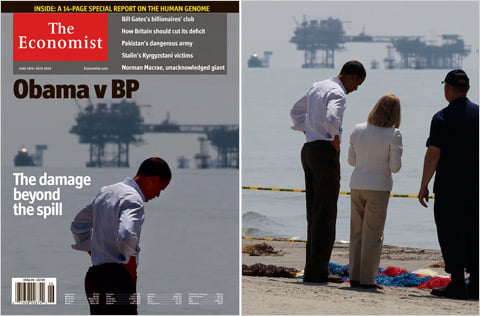
Omitting Information that Changes Meaning. Eliminating an element of a photo can change the way it is perceived entirely. Take this image of Obama for example – in the altered photo it appears that he is looking down in frustration and defeat, when in reality he is simply listening to the woman (who has disappeared thanks to the powers of photoshop).
Misusing Statistics to Push Your Point. When it comes to statistics there are many things that can go wrong that make data mean something completely different. A few of the examples explained in this article by Mona Lebied, to name a few:

- faulty polling: if the question is phrased a certain way, the answer can change
- flawed correlations: if you compare enough data points, similarities will appear where there is no legitimate correlation
- data fishing: using tons of data without any hypothesis means seeking conclusions that do not exist
- data omission: it is easy to use only the numbers and data that support your claim
- selective bias: omitting or even adjusting data to make your point stronger
- sample size: if the amount of people polled is under 200, it should be considered invalid
There are many more sins of visual storytelling out there, but after reading this I hope that you keep in mind how the actions you take as you create a visual can alter it’s perception – and even the truth.
CNET News Staff. “Pictures that lie (photos).” CBS Interactive, 12 May 2011, https://www.cnet.com/pictures/pictures-that-lie-photos/.
Lebied, Mona. “Misleading Statistics Examples – Discover The Potential For Misuse of Statistics & Data In The Digital Age.” Datapine, 8 Aug. 2018, https://www.datapine.com/blog/misleading-statistics-and-data/.
The New York Times. “Staging, Manipulation and Truth in Photography.” The New York Times, 16 Oct. 2015, https://lens.blogs.nytimes.com/2015/10/16/staging-manipulation-ethics-photos/.
 Emma Lao