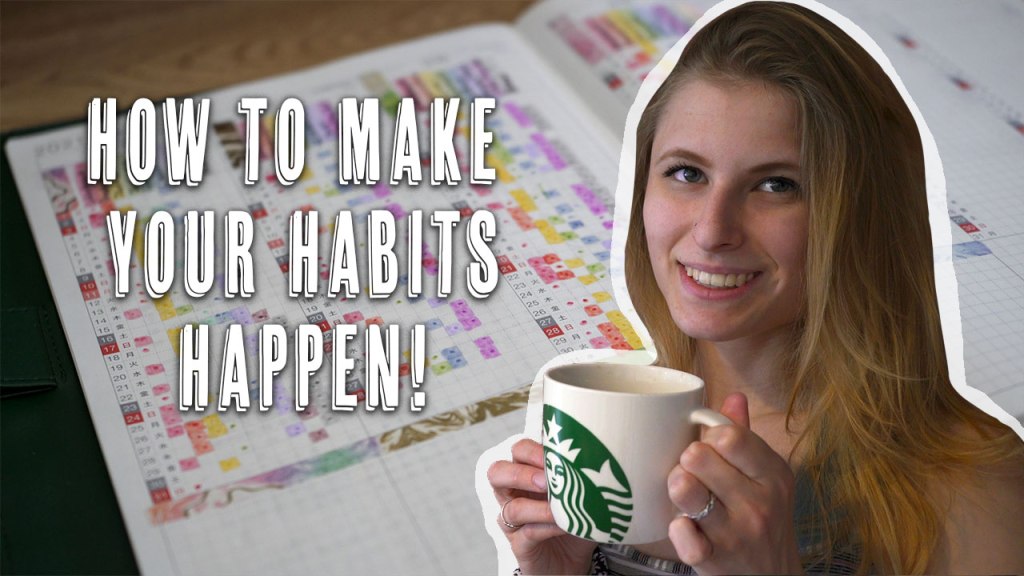
This week I practiced my filming and editing skills by creating a how-to video. In the spirit of my YouTube channel, I decided to make a how-to based on habits and productivity.
Reading & Writing: Film Sequence
In preparation for the filming of the video, I read that chapters about basic sequence and screen direction from Tom Schroeppel’s Bare Bones Camera Course For Film And Video.
A basic sequence in video is composed of a combination of wide/establishing shots, medium shots, close-ups, and cutaways. Whenever a cut is made the difference between the first and the second should be both in angle and size so that it is not mistaken as a jump cut. Schroeppel explains that “each new shot should, if at all possible, involve a change in both image size and camera angle” (52).
Cuts should also be on the action, meaning that an action is continued smoothly throughout the two shots. Clean entrances and exits are also important to give the viewer some orientation for the scene.
Screen direction mostly concerns the 180 degree rule – the camera should never “cross the line”. If the camera moves past the 180 degree line that it established it can cause confusion for the viewer. If this is unavoidable, the editor can use a cutaway to lessen the confusion.
Research to Inform: Continuity Editing
To be sure that I understand continuity editing in practice, I looked at a few scenes from my favorite films to see how they shot the same action in multiple angles to make smooth cuts.
This scene from The Handmaiden (2016) begins with one long, continuous shot but goes on to have several cuts – all of which are smooth and invisible to those who aren’t looking for them. First there is the cutaway/POV shot of her looking a the portrait. When she gets to the hall between her bed and the lady’s bedroom, there are multiple angles of the same conversation – one from her bed, another in the hall, and another outside the house looking through the window. The scene closes with a cut on action when she hears a noise as she’s peeking to the lady’s bedroom. For all of these cuts, the angle and distance from the subjects vary, making it smooth and appealing.
The music video for Anna by Will Butler is one of my favorites, partially due to the upbeat and constantly-moving editing. The video is constantly in motion – almost every cut is a cut on action so you barley even notice that the angle has changed. It is almost as if it is one long take until the 1:11 mark since the cuts are so seamless. When the sailors and Emma Stone begin to dance, the cuts are more obvious, but it is cut so that the dance is continuing so again it is smooth. There is even an invisible cut at 3:15.
A very common use of continuity editing in video is during conversations. In these Arrested Development scenes the camera changes angles (almost all of them “over the shoulder”) quite a bit, but it is such a natural convention at this point that it is not disorienting to the viewer at all. Something to note here is that the editors had quite a bit of wiggle room when cutting these scenes since there were many cutaway shots of the many family members.
Create: How To Form Habits and Reach Your Goals
In order to make this video match the theme of my YouTube channel, I did have to bend the assignment’s rules a bit. Instead of a single action with multiple angles over many takes, I decided to do many actions on a few takes, giving each action at least 2 angles and cutting on action, and having clean entrances/exits whenever possible.
While I am not 100% happy with my audio quality, considering I had to create this in one day (one of my goats was in labor and gave birth this weekend!), I am still content with the result. I think it is a decent explanation of the content of the book I am summarizing and I hope it gives value to mu subscribers!
 Emma Lao