Since 2019 I’ve been exploring how to use different planners and journaling systems and I’ve (finally) decided on what planners and journals will be a part of my routine in 2023. Here is the lineup, going from smallest to largest:
This cute little notebook is what I use for a simple desk task list. I set it right under my monitor so I can see what tasks I have to do for the day and easily add/edit/mark off what I’ve done.
Using To-Do lists have many benefits, such as reducing anxiety and giving structure to the day so you can use your mental energy on bigger and more important things than keeping track of every little thing in the day.
When I saw this lovely little pocket notebook in the bookstore I couldn’t help myself. It is a simple planner with a week spread on one page and a botanical illustration on the other.
This neat little book is from a friends Redbubble store – when you’re able, support local artists! There isn’t anything particularly special about the inside, but I figured that having a completely blank page gives me more room for my thoughts and feelings that may come up during therapy.
This cute notebook is what I use for my notes from studying tarot & for journaling about my tarot readings. A ritual that I’ve found great for connecting to my intuition via journaling is a daily tarot reading. All of my thoughts and findings are logged in this journal. I look forward to filling these pages!
My main journal is this cute A5 genuine leather notebook. Here there are no rules except to put the date on the top line of whatever I’ll be writing or drawing.
It is no secret that journaling can help with mental health by managing anxiety, reducing stress, and coping with depression. Adding daily journaling to your routine can bring more awareness to what is and isn’t working for you in your life and therefore make way for positive change. 🌅
I’ll be making posts on the Hobonichi & all of the other journals so if you’re interested in tips on wellness, productivity, and creativity follow my blog and subscribe to my YouTube channel.
This is my final week of college so I would like to use this post for a moment of reflection. For my first graduate class I created a whitepaper on Deep Work in Documentary Production. I will be analyzing how this advice has worked for me so far and some new things that I have learned since then.
A Distracted World
In the whitepaper, I explain how the “attention economy” is enveloping more and more of our time. With the pandemic, things have only gotten worse.
When working at home or in a personal office, like many documentary producers do, it is even more difficult to avoid distractions. Through your computer you have access to hundreds of social and informational sites within seconds. Even away from your desk, your phone is a tether to constant connection and distraction.
In 2020 and 2021, it is not only documentary filmmakers who are staying at home – it jumped to 71% because of the pandemic. Working from home is not a bad thing, it can actually make your time a lot more productive – if you take the right steps to ensure that you do not get trapped by the only increasing distractions.
How to Do Deep Work
So how can we work from home, or anywhere, distraction-free and fully focused?
The first step is to decide what your deep work schedule looks like. There are three different types of schedules; bimodal (taking a chunk of days to focus on deep work), rhythmic (carving out time within specific days of the week), and a hybrid of the two. I had concluded that the hybrid schedule is best for documentary production where you can use the rhythmic philosophy for the “shallow work” of documentary production and the bimodal philosophy for “deep work”.
Having planned, filmed, and edited a documentary since that time I think that the “best” schedule depends on who you are and how you work. The bimodal philosophy can be extremely draining when you dive fully into a project and nothing else for a few days. I had done two very taxing shoots that would be in the category of bimodal and I can honestly say that it was not a stable way of working for me.
When I was editing my film, I tried the rhythmic philosophy: every morning I would get up at 5:30 AM to do another cut of the film. I would usually be done by 10 so I was able to use the rest of the day to attend to my other habits, duties, or shallow work.
Part of the reason that this was such a productive time for me was because I did this work in an uninterrupted and distraction-free environment. The apps on my phone would be locked (and I would use my phone for a Pomodoro timer) and my only task was editing – work that is definitely valuable and deep.
When to Do Deep Work
Carving out a chunk of the morning for deep work is no small task.
We only have 24 hours in the day, so we must make the most of it. Many people make the mistake of seeing the eight or nine hours they spend at work as the day and the time before and after it as bookends when we have nine more hours of conscious time to do with as we please.
The easiest way to make sure that you actually take advantage of each hour of the day is to find a proper planning system where you can plan exactly how you spend all of your time. While in my whitepaper I suggested using Trello, I have since moved to a physical planner, namely the Hobonichi Cousin.
Another tactic that I am still getting used to is living by the “hell yes!” or “no” methodology. I have been so close to burnout several times in the last few years, mostly because it is difficult for me to say no to opportunities that I am offered. (Actually, just last week I accepted two freelance gigs for the week of my finals – had I reminded myself of this method, I would not be writing this blog at 1 AM and two days late.) Really I need to practice what I preach, so this is a reminder for myself as well: only say yes when it is a hell yes, otherwise say no thank you.
Why Deep Work is Important
Deep Work is not only valuable in the sense that it creates something that is useful, entertaining, and unique; it gives the person doing the work purpose. In the whitepaper I talk about Steven Pressfield’s The War of Art and how it addresses the pain of facing resistance – a resistance that is strong, brutal, and ever-present – in order to create your life’s work.
Ask yourself ‘if I were the last person on earth, would I still want to be doing this?’ If your answer is yes, then you know that you can and will face any resistance necessary to create meaningful and irreplaceable work.
As my job search begins, I must keep this vital question in mind. I genuinely want to do work that is meaningful and that can allow me to make change in the world. I want to work somewhere where I am willing to face the resistance every single day with pride and courage. After reflecting on my whitepaper and the experiences I have gone through to get to this point, I am ready and more excited than ever.
In this blog post I will explain the four laws of habit creation from James Clear’s book Atomic Habits. To see the video version of this post, watch the video below!
Law #1: Make the Habit Obvious
The first law of creating a habit is to make it obvious. The first way you can do this is to create an implementation intention. Simply fill out this statement:
“I will [BEHAVIOR] at [TIME] in [LOCATION].”
One of the first habits I strive to do daily is reading, so my implementation intention for my reading habit looks like this: “I will read at 8:30 AM in bed.” Next, you can use habit stacking to keep the momentum going:
“After I [CURRENT HABIT] I will [NEXT HABIT].”
My ideal day also starts with a session of yoga, so my habit stacking looks like this” “After I read, I will do yoga.”
One of the most important steps in this law is to set up your environment for success. Make the habits you’d like to do as easy to reach as possible and those you’d like to break as far away as possible. It is natural for us to take the path of least resistance, which is why we can easily find ourselves scrolling through social media for hours on end – because it is easier to do that than to get what you need to get done. So, do the work to make sure that path of least resistance the is the one you actually want to go down.
Law #2: Make the Habit Attractive
One of the most popular ways of making a habit more attractive is to reward yourself with something after you have completed it. If you’d like you can even create another statement to clearly define the reward:
“After I [HABIT] I will [REWARD].”
Continuing with my ideal morning, I will only drink coffee once I have already read and finished some yoga.
You can also join a culture or group where your target habit is a normal practice. Even having a single accountability partner can help you with that, but in larger groups you may learn more and be inspired about what you are trying to make a regular practice.
If one of your habits happens to be journaling (especially using a Hobonichi) check out my Facebook Group which has discussions on journaling, productivity, creativity, and habits.
One final way you can make your habit more attractive is to create a motivation ritual. It can be drinking a cup of coffee, doing a stretch, listening to a certain song – anything that gets you pumped and ready to get to it. Personally, I love going on walks with my dog. The combination of sunlight and exercise energizes me and simply makes me happy (can I get a hell yeah for Spring finally arriving?).
Law #3: Make the Habit Easy
Again, environment plays a key role in this law. Make sure that you can get to your good habits in as few steps as possible and try to make your environment bad habit-free. An excellent way to do this is to simply not buy things that feed into certain habits or to download software to lock you out of certain programs during an allocated time. You may think that these steps sound excessive, but humans underestimate how little self-control we actually have.
Try to automate habits that you can as well. You can’t do this for every habit of course, but for every habit that is automatically done there is another that you can focus on.
If you are having trouble actually sitting down to do your habit, try out the 2-minute rule. This is when you only plan to do 2 minutes of whatever habit it is you want to do. The reality is that once the timer goes off, the majority of people will want to continue. Sitting down and getting started is the biggest battle there is when it comes to habits.
Law #4: Make the Habit Satisfying
Again, it is important to give yourself some positive reinforcement after you complete a habit. Give yourself a small reward each time you complete a habit so that you equate that habit with positive emotion.
A great way to make a habit super satisfying is to keep track of it in a habit tracker. I am pleasantly surprised with how full mine has been lately after I became serious about following the advice from Atomic Habits.
While all of these tips have been helpful to me, it is also important to know that this is not something that comes easily. Sometimes you will have weeks where you are on a roll and being super productive, and others where the habit tracker is left completely blank. This is normal and it is super important to be kind to yourself. If you drop off (like I did for 2 months straight when the pandemic began) just know that in time you will breathe, relax, re-envision, and plan how to bounce back.
If you enjoyed this post, consider following my blog and subscribing to my YouTube channel. Of course, if you would like to learn more about habits, check out Atomic Habits by James Clear – I’ve only scratched the surface in this post.
What tip did you find most helpful? Are there any habits that you are having trouble maintaining that you might have a plan to change? Leave a comment below!
Last week I had the pleasure of interviewing Alaina Fingal from The Organized Money, a professional planner who was full of wonderful advice and insights when it comes to using a planner. In this post I will highlight some of the most valuable info she shared, but if you are interested in listening to the full interview check out the podcast here:
Digital Planning Does Not Always Work
Like many, Alaina’s first experience with using a planner was when her school provided her one to write down her homework assignments when she was in the 5th grade. When she got older, though, she felt as if she had to be more “adult” and switch to a more mainstream and professional method by using digital planning alternatives. This works for some, but for her it did not. At that moment she thought:
“Let’s just be us and go back to the planner.”
In our discussion we concluded that something is lost when you go digital. Using a paper planner every day sets up a routine and forces you to be more aware of how you spend every moment of your day.
“I’m more connected to what I have to do when I am writing out this to-do list.”
Be Kind to Yourself & Go Slow
Currently, Alaina is using seven separate planners to track her day. Do this mean that you have to do this? No! In fact, when she first began planning in 2018 she was using a single planner. As she continued to get in the habit of using her planner and refined her system to work optimally for her, she branched out. Even then, when she was a new mother, she stopped planning altogether.
A planner is not supposed to be a burden or something that you HAVE to do, it is a tool that should only help. So when it doesn’t help, step back and re-assess. Maybe the system you are using now isn’t right for you, or maybe you are simply doing too much.
“You have to know the seasons of your life.”
I have had a time where I had to step back and re-assess how I was using my Hobonichi Cousin. When the quarantine began last year, I completely dropped off on my daily journaling and habit tracking. At the time, I was super hard on myself, but looking back on it I realized it was just a different season. Once you are kind and forgiving to yourself, planning becomes much more joyful.
Trust Your System
One of Alaina’s biggest mistakes in her planning journey was giving into the FOMO. Whenever a new planning system dropped and it looked attractive, she would ditch her old method and try to adopt a new one, without asking herself if it was a system that fits her life or her style.
“I was afraid of settling into my system.”
It may take time to create a system that works for you, but once you have it and it is working trust yourself and the system. That’s not to say that there aren’t plenty of people out there who give wonderful advice about creating systems (Alaina and myself included), but be sure that you adapt whatever advice you follow to work for you.
Use Your Planner for Mental & Physical Health
In her planner, Alaina tracks what she calls “essential habits” – sleep, diet, and exercise. Unfortunately, these are aspects of life that many people neglect to attend to due to stress, busyness, or lack of direction. Having a planner to remind you to at least pay attention to these essential functions is a huge step toward making positive change.
Planning also makes room for more attention towards mental health. Alaina has a dedicated “faith planner” where she tracks her mood, meditation, scriptures, and prayers – by writing in this daily she is reminded to take time for herself and her mental state.
No matter what you are trying to improve, track, or organize in life, putting it in a planner will make it happen. If these tips helped you, consider following my blog or subscribing to my YouTube Channel. If Alaina’s insights interested you check her out too!
What do you like about planning in a paper planner as opposed to digital? Did any of these tips speak to you, or do you have any to share? Comment below – I would love to know your thoughts.
At the end of every month I open my Hobonichi Cousin planner and assess how my month went in regards to habits, scheduling, and my month’s goals. Yes, dates (and time in general) are a fabrication of mankind and may seem arbitrary – but there is a lot of power in making a fresh start every month.
In this post I will break down my process for mapping out my monthly goals and how you can follow those steps to become a better and more balanced you.
The Three-Step Process: Reflect, Ideate, & Create
When I was researching different methods of goal creation, I came across this wonderful video by struthless. From his process for creating goals for a new year, I created an abridged version for a month-to-month plan. I still suggest you check out his video (and his entire channel) if you want to know more or go more in-depth with your plan.
Step One: Reflect
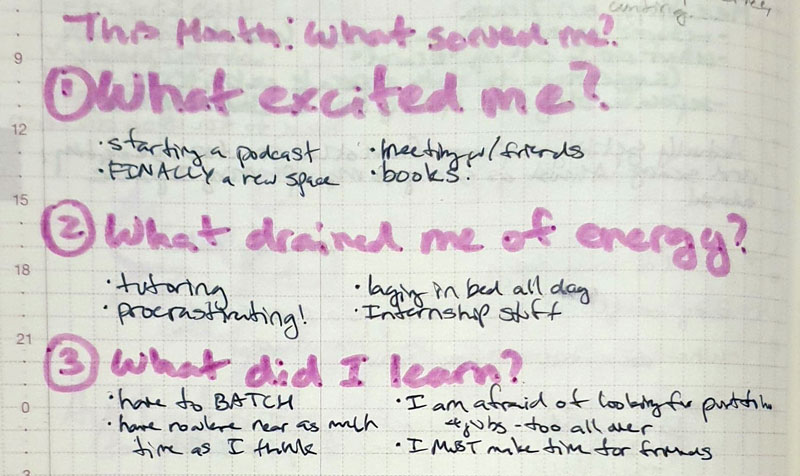
Before you can plan how to make this month better than the last, you need to first see what went well and what went poorly in the last. Ask yourself (and write out your thoughts about) these three questions:
What excited me?
What drained me of energy?
What did I learn?
My thinking process (yes, it is messy – but that’s me!) looked something like this:
Step Two: Ideate the Perfect Month
Next, assess two or three actions in each category that you could take to make you month better in these ten categories:
Personal Life & Family
Work, Studies, Profession
Belongings
Relaxation, Hobbies, Creativity
Friends & Community
Health & Fitness
Intellectual
Emotional & Spiritual
Finances
Bucket List
While you are typically thinking of all of these aspects in them back of your mind, specifically writing them out on paper makes the action plan much more clear and in-reach.
After all of your thoughts are written out, write these questions (warning: things are about to get introspective):
Why do you want this?
Who do you have to be to do these things?
What would you have to say no to?
What would you have to say yes to?
How will you persevere through hardship?
Why do you deserve this?
Again, here is my messy thought process:
Step Three: Create Goals & Habits
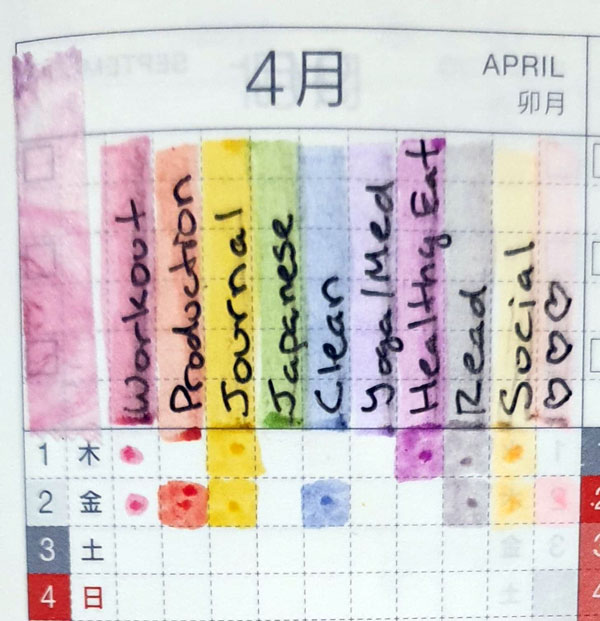
Finally, see which of these actions you would like to pursue the most and make them into habits. The Hobonichi Cousin has 10 slots in its habit tracker, but if you are new to habit tracking I would suggest you start with no more than six and work up from there. Here are the habits that I decided to go with:
For clarification: social is spending at least 30 minutes with a friend (virtual or otherwise) and the hearts are spending meaningful time with my husband (like doing something other than eating and watching TV together).
I also like to pick three major goals and map them out on the daily page that begins each month in my Hobonichi. This month I chose to focus on friends, finding my creative identity, and giving myself time for inner awareness.
To see my entire monthly planning process, check out my Plan With Me video for April:
I hope that you gained some insight on planning your monthly goals from this post! If you would like to learn more about productivity, habits, wellness, and creativity follow my blog and subscribe to my YouTube channel. If you are a fan of the Hobonichi, I also have a Facebook group where members share how they use their planners and journals.
Do you have another way of creating monthly goals? Let me know in the comments!
In these past few months I have delved into the the issues with modern-day life in regards to productivity and life balance. For my final white paper, I decided to examine how adapting deep work into the field of independent documentary production can allow you to organize your life’s work and make meaningful content to share with the world. I discuss the what, how, when, and why of deep work and end my paper with an interview with Ashley Brandon, a documentary filmmaker and full-time professor. Feel free to download and share.
In these past few months, I have been arguing for the utility deep work provides and giving pointers as to how to make time for it. However, even after following what I have been writing, I am still struggling to do deep work consistently. In this week’s readings, I have found that I am neglecting to acknowledge a flaw in my thinking: it is impossible to make time. We have 24 hours each day and seven days a week to live our lives – there is no negotiating that.
One of Bennett’s first ideas is that our society has a counterintuitive tendency to value money over time. He argues the proverb “time is money” is a foolish way to think, since you can make money with time but you cannot make time no matter how rich you are.
“We shall never have more time. We have, and have always had, all the time there is.”
Personally, I spend about 28 hours a week working and about 7 hours getting to and from work. That means that every day I spend 5 hours on average on my income. I am also a full-time student and spend about 11 hours in class, or 1.5 hours per day. Add on homework, school projects, and travel and I would say it would be a total of 20 hours a week or about 3 hours a day. So there is 8 hours for school and work, then I assume another 8 for sleep and I am still left with about 8 hours on average of open time. Not so bad…so how do I spend this time?
Bennett suggests spending at least an hour and a half of it on “cultivating the mind”. His version of this was reading “the work of stoics”. Instead of that, why not use it for Deep Work? An hour and a half every day of productive time would allow us to make large strides in projects in a short amount of time.
The remaining six and a half hours is up to you. My suggestion is that you simply plan each hour. Bennet says “you can turn over a new leaf every hour if you chose,” so make the most of your time – these are the hours that will allow you to be you. The only thing that I would not advise you do in this time, however, is using you phone mindlessly.
I have already discussed the damage that constant connection can have on your work and life in previous posts, and in Cal Newport’s third rule of “Deep Work” he gives some guidance onto how we can actually use social media to enhance our time rather than letting it suck it all away.
Newport notes that many knowledge workers approach the issue of social media use in a rather binary and crude manner by either embracing it wholly or cutting it out all together. He instead suggests that we take “the craftsman approach to tool selection” by identifying the core factors that determine success and happiness in both our personal and work lives then analyze each tool to see if its benefits outweigh its negatives in regards to our core factors. Newport calls this process “Applying the Law of the Vital Few” and breaks it down into four steps:
Identify high-level goals in your personal and professional life.
List 2-3 important activities that help satisfy those goals.
Consider the network tools you currently use and rate them by positive, neutral, or negative impact.
Keep only the tools that have a positive impact.
He also suggests doing a social media detox (much like the one I wrote about) to test for two things: first, if those days wold have been notably better if you had used social media and second, if people actually cared whether or not you used the service. In reality, you may find that one, your days may have quite improved, and two, that people tend to notice things much less than you think they do.
By limiting your social media using it with intent, you will become a part of what Newport calls “The Attention Resistance”. In the chapter of “Digital Minimalism” by the same name, Newport urges you to fight against the tools that consider themselves to be “fundamental technologies” as they are simply trying to get (and keep) your attention so they can make an income. He lists a few practices that may help if you are still finding yourself to be carried away by the constant connection.
Remove Social Media From Your Phone. The vast majority of time wasted on social media is when accessing it from the device that you keep by your side 24/7. According to Newport, 88% of Facebook’s earnings come from its mobile app. So, if you do not want to completely cut off your far-away friends and relatives and delete all the pictures you have complied, simply delete any apps you still use (but use a little too often) to force yourself to take the extra step and open up you laptop. It is surprising how such a small deterrence can save you so much time.
Turn Your Devices Into Single-Purpose Computers. In the olden days of floppy discs, PCs were only able to run a single program at a time. Now, depending on the size of your RAM, the possibilities for multitasking are nearly infinite. To avoid unwanted distraction caused by social media turn your PC into a single-use device. Only have one program open at a time so you are not tempted to simply swipe left or right into another world of distraction.
Use Social Media Like a Professional. To use social media wisely, that means you must think carefully about why you engage with it and who you engage with on it. Newport suggest keeping the amount of connections online down to the Dunbar’s Number of about 150 since that is how many people we can actually maintain relationships with. In addition thinking carefully about who you engage with, try not to use social media as a tool for entertainment. When it comes down to it, you will barley remember any of the content you see and there are much better options for how to spend your time.
Embrace Slow Media. Now that you are using social media only to keep tabs on close family and friends, it is time to find where to receive your information from. According to Newport, the best way to do this it to find a small group of authors or content creators who you trust and read their content primarily. However, he also suggests that you seek out arguments against your own as to not get trapped in a vacuum of repetitive (and potentially misguided) information – something that is very easy to do if you get your information for your friends and family on Facebook.
Dumb Down Your Smartphone. If none of these practices seem to work for you, it is time to take the next step. Save yourself time and money and go back to a flip-phone. If you need to access the internet, it is likely that you have a laptop with you anyway. Yes, it will be annoying to learn how to text using the number pad again, but the time you save by saving yourself from instant access to social networks can be life-changing. However, there is no need to do this if your smartphone is not enough of a problem and you are able to apply the rest of the practices with ease.
This is a lot to take on at once, especially since we have grown so reliant on the convenience of today’s tech. If you make mistakes or cheat every once and a while, don’t be too hard on yourself. As Arnold Bennett says:
“Be content with quite a little. Allow for accidents. Allow for human nature…especially your own…a glorious failure is better than a petty success.”
At the very least be mindful of how you use your days. I am still very young, but have come to realize that time is moving faster and faster and the time I have for myself is less and less. So when I do have time for myself, I will use that time to strive for the goals I have for myself. Bennett implores you to strive for your goals because even if you do not reach them, you will be more fulfilled than those who never even tried.
It is not new knowledge that we are in a distracted world. As I have discussed in my previous posts, we are addicted to constant communication and screen time, so much so that it is difficult for many people to actually sit down and read something.
In Clive Thompson’s article Social Media is Keeping Us Stuck in the Moment, he contributes this addiction to distraction in part to the “reverse chronological design” that almost all news and social media sites utilize. In this design, the most recent posts and articles are at the top and you must scroll down to go back in time, which he says that this is damaging to how we consume information.
Thompson references Harold Innis’ On the Bias of Communication which was published way back in 1951 to show how this argument is not new. Innis attributed our “obsession with the immediate” to daily news, which was more disposable and discarded quicker than past forms of media.
To put it simply, constant news (whether it be in the form of tweets or news articles) is addictive. Thompson points out that it is not only making us more distracted, but more prone to believing in the “shiny new headlines” than actually researching a topic and understanding it.
What scares me the most about our addiction to technology is how it is hooking our children in from the get-go. In the article The Art of Staying Focused in a Distracting World, James Fallows interviews ex-Apple and Microsoft worker Linda Stone who now shares the dangers of distraction and being in a state of “continuous partial attention.”
Stone points out that in different situations we need to utilize different attention strategies. For example, a vital strategy is used when playing alone as a child and “you developed a capacity for attention and for a type of curiosity and experimentation that can happen when you play. You were in the moment, and the moment was unfolding in a natural way.” She argues, however, that the huge role that technology plays in many children’s lives does not allow for a child to develop these attention strategies.
From a young age, children learn through imitation. Kids are not inherently fascinated with phones and technology, they are fascinated with what mom and dad are fascinated with. Stone says that children learn empathy through eye contact, so what happens when their parent’s eyes are constantly on their phone? According to Stone, “What we’re doing now is modeling a primary relationship with screens, and a lack of eye contact with people.”
Stone believes that things are slowly getting better and the generations raised on screens are becoming more aware of the downsides of their attachment to a screen, but that we must create a capacity for a “relaxed presence” by doing activities that promote “mind and body in the same place at the same time.”
In Cal Newport’s second rule of Deep Work, he argues that these activities can not only aid in personal well being, but in your ability to focus on a task and work deeply. The chapter entitled “Embrace Boredom” outlines four ways you can train yourself to quell the urge to give into distraction.
Manage Your Breaks from Focus
Newport’s first guideline on embracing boredom is to take breaks from focus rather than taking breaks from distraction. He argues that if you schedule the exact times you can use the internet and keep all other time internet-free, you will train your resistance to distraction since the option will simply not be there.
Do Nothing But Work for a Set Time
Newport’s next guideline is to allocate the time in your day to focused work. He models this guideline on Teddy Roosevelt’s method of focus during his time in school: he would spend every minute of spare time between 8 am- 4 pm on getting work done so he could have time to relax and participate in school organizations. Newport suggests that you can set a personal deadline for a project to force more intensity during you work time.
Practice Productive Meditation
The final guideline Newport gives that I will be exploring is to “meditate productively.” This involves taking any time you are physically occupied (walking, jogging, swimming, showering, or driving) to focus on a single well-defined problem. Newport gives three steps to productive meditation: review the variables of the problem, define the “next step” question, then consolidate your solution in a clear statement. Not only does this act allow you to use otherwise unoccupied mental time, but it train yourself to resist distraction and remain focused.
I was particularly drawn in by this idea of “productive meditation”. I have jobs all over the state which means that every week I spend upwards of seven hours in a car. I wanted to see how other productive people used their time on the road, so I read the Forbes article Make The Most Of Your Commute With These Eight Productive Tasks by eight young entrepreneurs. Their suggestions were insightful and actually connected to quite a few of Newport’s ideas.
“Record Your Thoughts.”Shawn Porat uses his time in the car to let his mind wander and record any interesting thoughts using a voice assistant. While this is not as intense as productive meditation, in my previous post I shared the benefits of boredom and how taking a break from stimulation can let you have good and interesting thoughts. I know for a fact that I have had some thoughts while sitting in traffic that I wish I had not let dissipate – from now on I will keep a journal in the notes app on my phone.
“Listen to Audio Books.”Robert De Los Santos suggests you listen to audio books on your commute so that you can prepare your mind for critical thinking you will have to do at work. For the past six months this has been my default driving activity – I have been able to listen to twenty books since May, which is incredible considering I had not opened a book for leisure since middle school. If you think this option isn’t for you due to the price (Audible is actually quite expensive) I suggest seeing what resources are available to you from you public library. I was able to listen to all twenty books for free using the app Libby – all I had to do was connect my library card and put the books on hold.
“Do High-level Strategy Work.”Fred Lam suggests you spend the time to plan out your day’s goals for yourself and you company since “without strategy, there will never be execution”. This is more in line with Newport’s productive meditation, but on a daily level. I would do this method, but lately I have gotten in the habit of doing this before my commute with my morning coffee and breakfast.
“Catch Up On the Little Things.”Stephanie Vermaas gives a tip to those who take the train or bus – use this spare time to catch up on emails, phone calls, or to get up to date on projects you are working on. This could be a good time for communication so that when you get to work you can turn it off and not have to worry about checking your email until later in the day.
“Conduct a Daily Review.”Shu Saito utilizes his morning commute by planning out his day, making sure that the most important tasks are at the top of your to-do list. He then spends the rest of his time letting his mind wander, using the silence to perhaps “wander onto a brilliant idea that could recharge your day or business.” This is when your voice assistant would come in handy.
“Listen to Music.”Jared Atchison does what is perhaps on of the most popular options – simply turning up the volume on some tunes that will let you have time to relax or set the mood for your day. I would go a bit further an create some playlists depending on the tasks that you are on your way to conquer to get you ready to face the day.
“Immerse Yourself in Industry-Related Materials.”Derek Robinson strays a bit from boredom by using his commute to get up-to-date on what is going on in your industry through podcasts, webinars, or audio books. While this is not quite what Newport had in mind for “embracing boredom,” it is useful for people like me who have very little time to explore these topics otherwise. Some of the audio books I have listened to were not necessarily industry-related, but work on some of the long-term goals and habits I have in mind for myself. Marie Kondo’s The Life Changing Magic of Tidying Up and Dave Ramsey’s The Total Money Makeover have already made an impact on my daily habits – something I argue you should focus on in another post.
Pause and Self-Reflect.Kevin Yamazaki gives the final tip for utilizing your commute that is the opposite of the last tip – avoid burnout by cutting off your work and using the time to reflect on your well-being and current conflicts that could be resolved in your life. He says, after all, “you are the driver for every project you push forward,” so you must take time to think of and take care of YOU.
It is okay to step away from work every once and a while – it is in fact quite beneficial. Train yourself to be used to boredom again so that you can use it to improve your quality of work and life. There is truly no good reason for you to be connected at all times; instead, take some time to connect back to yourself.
We all know that deep work is important and does nothing but good for us – but when it comes down to actually doing it, where do we start?
In Cal Newport’s Deep Work, he gives some guidance on how to make the magic of “deep work” happen through a set of rules. The first rule being, of course, to “work deeply”. More specifically, the first rule is to add routines and rituals to your life that make the transition into focus easier.
Determine a Depth Philosophy
The first step in this process is to “decide on your depth philosophy”. Depending on the person and the type of work, their philosophy and approach to deep work will vary greatly.
There are those who may follow the monastic philosophy where they radically minimize or fully eliminate “shallow distractions” so they can focus on work. This could be through only allowing communication via post mail or not allowing outside contact at all in the aim to focus on a clear, discrete, and individualized contribution to the world.
For those who cannot simply cut off all contact from the world the bimodal philosophy may work better. In the bimodal approach, you make those eliminations only in periods of time (a minimum of one day) where you are focusing on deep work. Scholars such a psychologist Carl Jung and professor Adam Grant use this philosophy, benefiting from both long periods of focused time and for “shallow” tasks outside of their typical work.
A more practical approach for the everyday worker is the rhythmic philosophy where deep work becomes more of a habit than an intense session. Comics like Jerry Seinfeld and scholars like Brian Chappell use this method of blocking off a set time in their day to focus only on their work in order to make time for everything else in their lives more worry-free.
The final approach is the journalistic philosophy, where you use whatever free time you can find to work deeply. This one should be practiced with caution, however, as it requires you to be confident in your ability to easily switch into a deep work mindset.
While I would like to say I am confident in my ability to focus, I simply can not. So, I am choosing to use the rhythmic philosophy – I will simply block out a few specific times in my week where I will wake up earlier to get work done…but it is not quite that simple.
Ritualize Deep Work
You have already determined your depth philosophy, so now it is time to go deeper. Deep work must become a strict ritual so that you can make the most of the time you have allotted for focus. Newport suggests addressing the environment, parameters, and supplements for your work.
The environment you work in is wildly important to your focus – if you can dedicate a spot to only deep work that is even better. In addition to location, the time must be set in stone as well. The more specific, the more likely you are to actually follow through. In the Behavioral Scientist article Remedies for the Distracted Mind, it is established that the best work spaces are those that avoid distraction – using only a simple screen and everything not relevant off your desk.
The next step is to define how you will work once you actually start working. Structure is key – know if you what resources you need for the work you are doing and ban/ignore all else. Don’t let shallow distractions like email and instant messaging let you think you are doing work – they are in fact quite harmful to your productivity.
The Behavioral Scientist article actually states that it may take up to 30 minutes to regain focus after checking one of these shallow distractions. Not only that, but it references a study where 124 adults were divided into two groups: one was told to check their email as often as they could and the other was told only to check their email three times a day. After a week the groups switched tasks and it was found that when the subjects were only checking email three times a day, they had “reported less stress, which predicted better overall well-being on a range of psychological and physical dimensions.”
Something that the article suggests you do to put yourself on the right track for blocking out these distractions is using an app like Stay Focused to block or put a time limit on any application on your phone (or your phone in general) during certain periods in the day. I have started to use the app myself and found that it is not only useful in making me stay focused while doing deep work, but that it makes me more aware of how much time I spend on each app.
Divide the “What” and “How”
Now that everything has been prepared for us to dive into actually doing it. We know what we must do, but how should we do it? Newport suggests you execute your deep work “like a business” by following the four disciplines that highly successful companies use as outlined in the book The 4 Disciplines of Execution.
The first discipline is to focus only on “the wildly important” – you must have a specific goal for each deep work session. As the authors of the book say, “The more you try to do, the less you actually accomplish.” Having a single tangible, executable goal not only means that you are more likely to get it done, but that when it is done you will be boosted by the accomplishment you feel having done it.
The second discipline is to “act on lead measures.” There are two types of measures: lag measures, which are what you are ultimately trying to improve, and lead measures, which are smaller behaviors that will support those lag measures. In the case of deep work, Newport suggests, the primary lead measure is the amount of time spent in deep work.
The third discipline is to “keep a compelling scoreboard.” Newport’s scoreboard of choice is a row of paper with a tally marked for each hour spent working deeply, the hours where he achieved a goal or finished a task being circled. Any sort of visual representation works – choose something that displays your “score” (hours spent in deep work) in an exciting and energizing way.
The last discipline is to “create a cadence of accountability.” This can be in the form of weekly meetings to share progress (which pressures you to show that there has been some) or planning your week ahead of time. My personal choice is to use a whiteboard in my room with a checklist of the major tasks I have to get done on each day, along with a portable checklist in my planner. Nothing is more satisfying than checking off all the boxes in a large list!
Cut off the Stimulation
The final step to doing deep work is to stop doing it. In fact, it is best to stop doing anything related to work at all. At the end of your deep work, shut down all thinking and all work-related communication.
Having downtime aids in creating insights we night otherwise never let ourselves reach. In the TED Talk How to Get Your Brain to Focus, Chris Bailey makes the conclusion that due to all this screen time and constant communication, our brains are over stimulated which makes focusing difficult. He says that we are victim to our brain’s novelty bias – the crave for dopamine release that ends up taking over all of our time to actually take a breath and think.
After doing research on focus, Bailey did a month-long experiment where he did a “boring” task for one hour every day from reading the terms and conditions to staring at the ceiling. What he found was that after a week, he adapted to this “under”stimulation and during these times great ideas and plans came to him simply because he let his mind wander. He concluded with the thought that we should re-discover boredom because distractions are not really the enemy – they are a symptom of over-stimulation.
In addition to allowing time for insights, being lazy lets you recharge your brain so you can be more productive when you are doing focused work. Also, as Newport points out, the majority of the work you would do after-hours is typically not important so you should save your focus for the more constructive tasks.
Now we know how to do deep work, but let’s step back an take a look at the why.
In previous blog posts, I have explored the tremendous effects that smartphones and the technology boom has had on the world and every single person inside. The article A Sociology of the Smartphone brings many of these effects to the forefront by reminiscing on the world before – a world of physical objects like pictures, cameras, keys, tickets, photos, calendars, and maps that we relied on. Now, everything we rely on is all in one device – a device that has become a part, for some a big part, of your identity.
Not only are the things we are reliant on in our phone, but as phones are becoming more and more widespread the option to use anything else is being taken away. This is especially harmful when it comes to sharing our personal data – surrendering our data is no longer becoming a choice, but a necessity. As Adam Greenfield says in his article, “whether we’re quite aware of it or not, we are straightforwardly trading our privacy for convenience.”
Greenfield ends his article with a quote from Winston Churchill: “We shape our buildings, and afterwards our buildings shape us.” While his application of this quote is to show how we have created this grim situation by creating tools like smartphones and communication networks. While I agree with this take, I think this quote can be used in a more positive and proactive way.
“We shape our buildings, and afterwards our buildings shape us.”
Even though these buildings have been created and we are becoming more aware of the negative effects they have caused, there is no reason that we can’t demolish them and create new buildings. This time, let’s construct the building with our well being, including our ability to focus, in mind.
Project management sounds rather intimidating. First of all, there are so many types of project management: Waterfall, Agile, a Hybrid of the two, Design Thinking, Kanban…the list goes on and on. These styles of project management are used by designers to outline what needs to get done and by who in order to reach goals for their products in a set amount of time, considering all constraints and possible setbacks.
According to the Wikipedia article on project management, while there are many types of project management approaches, successful ones typically focus on these four main aspects: the plan, process, people, and power in a given project. It is important to have a clear idea of what resources are available to you and how you should allocate all of your resources to be the most effective it can be.
With those aspects in mind, a project continues on to begin its process groups: initiation, planning, executing, monitoring, and closing. In initiation, the scope, costs, and schedule must be defined.
According to the video Project Planning Process: 5 Steps To Project Management Planning the planning process itself is broken down into five steps: creating the plan (they suggest using templates) to mobilize the project, breaking down deliverables and receiving as much input as possible about them, determining dependencies and potential risks/issues, creating a solid timeline, and assigning resources to the project.
In executing, you simply follow the plan that was constructed in the last step. At the same time, you are monitoring and controlling the project – you should be asking “where we are”, “where we should be”, and “how we can get on track again” then implementing what resources you can to improve the process.
Now that the project management process itself is a bit less intimidating, how can I apply this to my life as a student? The farthest I have gone in “managing” my deliverables is by using myHomework. While it has proven to work for me in the past (all the way back to freshman year of high school), my projects are becoming more complex and include multiple steps that need something a bit more visual and organized than a simple list.
While it will be sad to let go of myHomework, I need something a little less linear.
As my projects are growing, I am in need of a program that goes beyond “incomplete” and “complete”. I needed to explore more applications that make sense for me to use as a graduate student and a filmmaker. I decided to go with Trello as it allows me to meet all of my organizational needs – I can create boards for each subject, change the lists to match the needs of each project, and create sub-lists for multi-step projects.
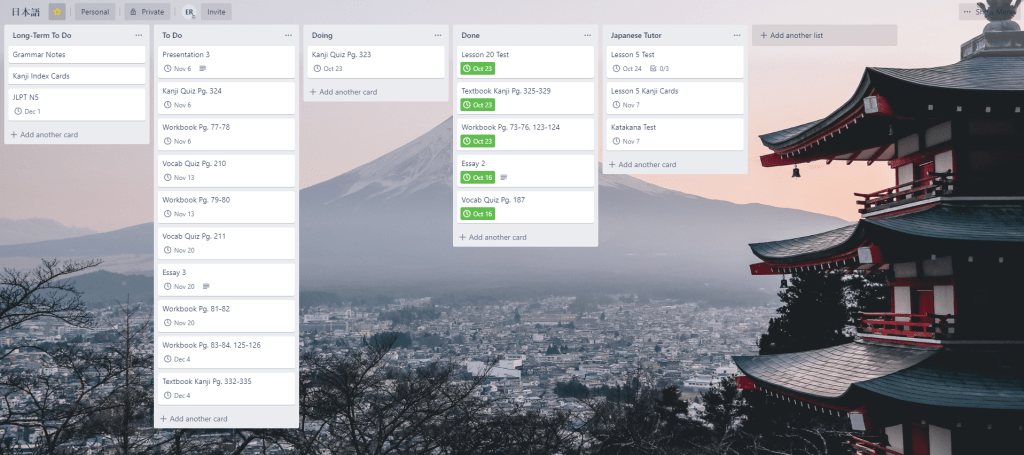
For more linear projects, I chose to go with the Kanban method for my lists: To-do, Doing, and Done. As you can see I also added “long-term to-do” for things that are longer-term goals and a list for my weekly tutoring sessions. Since it is so easy to create the cards, I went through my syllabus and added the rest of the assignments for the semester to the “To-Do” list- I will simply drag the cards over to “Doing” once they are assigned in class.
While the simple style of myHomework works well for classes like Japanese, isn’t this so much more appealing to the eye?
What is wonderful about Trello’s versatility is that it also suits my needs for film projects. In Matt Jacobs’ article How To Use Trello for Video Production Project Management he highlights Trello’s collaboration feature and explains how to use tags to assign each task to a specific person. It is also useful that you can set deadlines for specific tasks – deadlines are important in filmmaking and there are many to keep track of.
Instead of using Kanban, I separated the lists by the different phases of production.
In Jacobs’ article, he talks about how editor Zach Arnold (known for his work on Glee and Burn Notice) converted to Trello from his old method of using index cards and post-it notes for his projects. Arnold uses Trello to its full potential by adding members, paperwork, a workflow checklist, and due dates to each task.
I added all of this important info: members, paperwork, a checklist, and the due date.
I even shared my Trello board with the other members in my group. Even though we meet twice a week, there is always someone asking for clarification about a due date or who is doing what or where a specific document is. Now, we simply have to remind each other to check the Trello board.
While I have found project management to be very useful in my school and work life, I felt like I was lacking in the project I am constantly trying to work on: myself. After viewing the video Work Smarter Not Harder, I realized that I need to focus more on the “why?”: I need to define the results I want from doing everything I do in order to improve not only my quality of work, but my life balance.
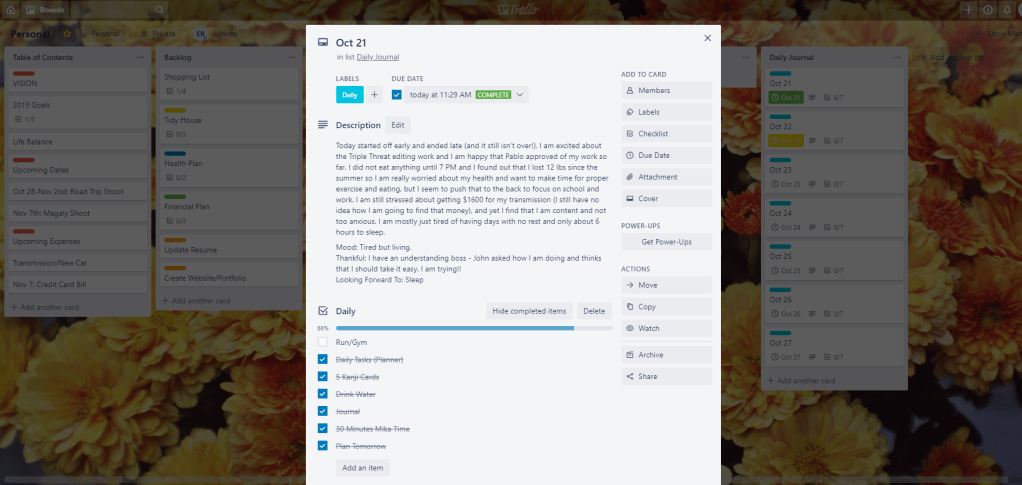
My first “Personal” Trello board looked like this. I thought it would be best to separate my lists by each aspect of my life that I wanted to improve upon. However, it somehow ended up looking bleak and overwhelming at the same time.
Then I read Britt Joiner’s article How To Build A Daily Habit Tracker In Trello (And Reach Those Goals!) and sympathized with her statement that she found herself on “auto-pilot” to complete tasks rather than working on long-term goals. She said that to remedy this, instead of simply listing projects, she “builds systems and habits that would hold [her] accountable to my goals along the way.”
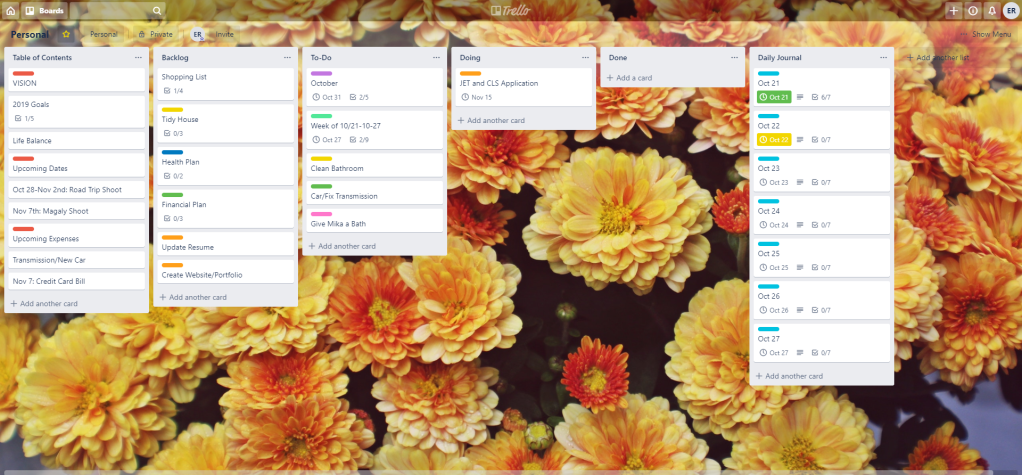
This was the end product – much more organized and easy to follow. I go in depth below.
She references James Clear’s idea that rather than focusing on your goals, you should focus on the systems you use to reach them. In Clear’s article Forget About Setting Goals. Focus on This Instead. he outlines the four main problems with goal-centered thinking.
First of all, he says that winners and losers share the same goal – it is only the winners who went beyond having a goal by implementing a system to reach it. The second problem is that achieving a goal is only a momentary change. If one instead focused on fixing problems at a “systems-level”, the outcome will automatically improve.
“Fix the inputs and the outputs will fix themselves.”
Clear, J. (2018, October 16). Forget about setting goals, focus on this instead. Rockyhouse Publishing. Retrieved from https://jamesclear.com/goals-systems
The third problem is that by setting a goal you are restricting your happiness, or rather you are saving your happiness for your future self who completed that goal. To solve this, we must not look at the binary system of goals (either reaching it or not) and focus on the system we can make to better ourselves.
The final problem with goals is that they are contradictory to long-term progress, since when we reach a goal we typically stop doing the good habits that lead to its achievement. Clear argues that our aim should be to “continue playing the game rather than winning it.”
With system-centered thinking in mind, I set out to follow Britt Joiner’s template for a habit tracker that would not only help me reach my goals, but improve my happiness for my present self.
First she suggests setting the building blocks by creating a table of contents with the overall vision and themes for the year, upcoming dates, and upcoming expenses. This is an at-a-glance reminder of why I am doing these daily habits.
Next, she suggests mapping out goals and projects with the “backlog”. However, since balance is the real goal, theses projects must be a priority or fit into the yearly goals.
Then she says we can “make the magic happen” in our “To-Do” list. She suggested creating a monthly and weekly card for the habits you want to keep repeating. The monthly list should include small actions that lead to larger goals and the weekly tasks should be smaller habits that you can look at and get done in a few minutes.
Finally, there is the “Daily Journal” list to promote creating the right daily habits. This list has a card for each day that includes a daily journal, some quick check-in questions (I chose mood, thankful, and look forward to), and a daily checklist.
I hope to create a similar board for my work life once I begin a daily office job following the habits suggested in the video 7 Work Habits You Need to Succeed – Project Management Training. For now, though, I need to hold myself accountable to improve my health and decrease my stress. By mobilizing my project plan to improve myself, I think I am heading in the right direction.













 Emma Lao