• Blog Feed

Emma Lao

Habits

Tarot

Wellness

Hobonichi

Productivity

Media Studies

  • YouTube
  • Instagram
  • Facebook
  • Goodreads
  • TikTok
  • Writing for the Spoken Word

    April 18th, 2020

    Of all the writing styles we have been studying, writing for the ear is the most unique. Typically a story is told through information that is revealed to the reader for them to interpret on their own. In audio-centered writing you instead focus on an giving the listeners an experience by following the action of a plot. The style of writing required to do so would be highly unconventional for reading, but works to keep the attention of the audio listener. 

    One of the most important things to do is keep your sentences short and to the point. As Jill Swenson says in her post “Writing for the Ear Instead of the Eye”, you should follow the ABC’s: be accurate, be brief, and be clear. While using complicated jargon or sentence structures may be appropriate for the written word, it is too easy to lose the audience or sound unnatural if you do so in spoken word. Everything you say should sound like everyday speech – if anything rolls off the tongue the wrong way find an easier way to say it. It is also useful to utilize punctuation to signify pauses or emotions that can only be heard otherwise.

    Another important tactic for audio writing is to show the audience instead of telling them. A perfect way to show rather than tell is to include some audio of the scene. In almost all NPR radio stories, they will introduce a change in scene by letting the audience listen to the environment for a few moments. For example, if they were visiting a soup kitchen they may play audio of the cooks calling out for orders, or if they were on a farm they may play audio of wind chimes and long grass in a breeze. This allows the listener to take a breath and let the scene in before they are thrown into the action.

    When you have finished your writing, no matter what kind it is, it is important to read it aloud to catch any awkward phrasing or simple mistakes. However, it is critical to do so for writing for the ear since this is how it will actually be presented. You also want to do it as many times as possible before the you present your material – practice makes perfect!

  • Long Form Summaries & Social Media Re-Purposing

    April 16th, 2020

    300 Words

    “When we go do you believe we go somewhere?

    Well, I know we’ll be going so, we will know soon,

    When all is said and done will we rise to join the sun?

    Or will we go beyond the stars with our Spirit beyond the stars and the moon?”

    Elaine Kolb, “Coming From Somewhere”

    In a summer night of 1973 in Atlanta, Georgia, Elaine Kolb was facing a downward spiral in life. Everything was becoming too much for her, and she had to escape – so she did. She ran and ran all night long until she blacked out from pure physical exhaustion to wake up with a song on her head and – finally – the feeling of inner peace.

    Since that night, Elaine’s life changed dramatically. That night would be one of her last times where she could move freely. In 1975, at the age of 25, Elaine was stabbed in the back by a stranger and became wheelchair bound for life, only a block from where she woke up with the song a year earlier. For a long time, she felt anger and despair for what had happened to her. But, she recalled that song and knew – she is still supposed to be here.

    She would end up going to Australia as a Fulbright scholar to share her songs about being disabled, continue her work as an activist for social justice and LGBT rights, and to touch the hearts of everyone in her life.

    She is now 70 years old and is burning with the same passion and compassion she had in her 20’s. While from time to time, like all of us, she feels the anxiety creeping back into her life, she calls upon the lessons from that song from the night in Atlanta – “Coming from Somewhere”.

    Facebook

    “When we go do you believe we go somewhere?

    Well, I know we’ll be going so, we will know soon,

    When all is said and done will we rise to join the sun?

    Or will we go beyond the stars with our Spirit beyond the stars and the moon?”

    Elaine Kolb, “Coming From Somewhere”

    In 1975, at the age of 25, Elaine Kolb was stabbed in the back by a stranger and became wheelchair bound for life. She did not let that slow her down at all.

    She would end up going to Australia as a Fulbright scholar to share her songs about being disabled, continue her work as an activist for social justice and LGBT rights, and to touch the hearts of everyone in her life.

    Singer/songwriter/performer/writer/artist/activist Elaine is now 70 years old and is burning with the same passion and compassion she had in her 20’s. While from time to time, like all of us, she feels the anxiety creeping back into her life, she calls upon the lessons from that song from a life-changing night in Atlanta – “Coming from Somewhere”. Hear her story here.

    150 Words

    It was 1975 in Atlanta Georgia when Elaine Kolb had a life-changing night.

    She was facing the worst panic attack in her life. Her mind was racing but the one thing that was clear to her was that she had to get out.

    She found a clearing in the city and began to run and ran until she collapsed.

    When she awoke the next morning, she felt at peace. The birds were singing, the sun was bright. And suddenly, she was given a song.

    Two years later, she would never walk again. Nevertheless, she continued her work as a songwriter, singer, and activist, sharing the stories of being disabled in a world that is working against people like her.

    Now 70 years old, Elaine Kolb has the same burning passion and compassion. Now and again when she is starting to feel negativity seep back into her life she recalls her song – “Coming from Somewhere”.

    Twitter

    It was 1975 in Atlanta Georgia when Elaine Kolb had a life-changing night. Two years later, she would never walk again.

    Now 70 years old, Elaine Kolb is still a singer, songwriter, activist, and goofball. Learn more about Elaine’s story here.

    50 Words

    In 1975 a woman’s life changed after the hardest night of her life. Two years later, she would never walk again. Now, Elaine Kolb is 70 years old and an active singer, songwriter, performer, writer, artist, and activist who reflects on that night and the lessons that came from it.

    Instagram

    In 1975 a young woman had a life-changing night. Two years later, she would never walk again.

    Singer/songwriter/performer/writer/artist/activist Elaine Kolb is now 70 years old and her spirit is stronger than ever.

    Read more about her story here.
  • Business Writing: Matter over Content

    April 16th, 2020

    Writing for the workplace may seem simple at first thought – all you have to do is be professional and get your point across and you should be fine, right? Well, that is true, but it goes much deeper than that. Every piece of business writing requires rhetorical awareness: the understanding of the purpose, audience, stakeholders, and context of the document. To execute business writing effectively one must go through a long and thorough process of defining the key characters of the writing and how it will affect them, establishing proper tone, and making all the information easily accessible.


    The main persons involved in each piece of business writing are the primary author (you), the audience (who will be making the decision), and the stakeholders (who will be affected by the decision that is made). In order to present your point in the most effective way you must preform an in-depth audience analysis where you consider every relevant aspect of the audience and stakeholders. This could include the needs, values, and attitudes when it comes to the subject and their physical, political, economic, and ethical context.

    In the kinds of writing that we have done previously the audience does matter and you do need to understand them to a certain extent in order to have one in the first place. However, it is absolutely vital in business writing that you have a deep understanding of who your writing will effect affect and how your writing needs to effect affect those who you are attempting to persuade.


    Tone is also an important part of business writing. It will vary from what kind of message you want to convey, but typically you want to have a voice that is confident, courteous, and sincere. Even if the message you are sending is negative, you want to give that message as eloquently as possible. This can be achieved by using proper emphasis and subordination, which is basically amping up the good and hushing the bad. It is also important to use non-discriminatory language that could turn a lighthearted and positive message into an automatically negative one for those who are excluded or demeaned (the most common case of this is assuming that males hold all dominant positions). These are all things that should be kept in mind in other forms of writing, but it is nowhere near as important since you are trying to sell your idea on behalf of a major company, not on behalf of the story itself.


    One of the final differences in business writing is the use of proper design. The document must be easy to navigate and should have a table of contents, page numbers, and specific headers. The information itself should be presented generally at first then become more and more specific with headers to match. Every sentence should be simple and clear so that anyone, including people who are not in the primary audience, could read it and understand. The layout of the pages itself are important as well; you should do your best to compliment the information with visuals that follow the Z pattern along the page. Balance and color choice are important as well. While in past writing types the design should be considered, it is again not as in depth as it should be for business writing.

    Overall, business writing requires a lot more focus on the audience, structure, and tone than on the content itself. As in all types of writing, revision is highly important. This is more true than ever in a business atmosphere where the last thing you want to do is waste your client or boss’s time since time is money.

  • Long Form Purpose Statement

    March 5th, 2020

    “There’s a well of water deep inside,

    High upon the mountain of our dreams,

    That catches every tear we’ve ever cried,

    And pour them out again in a cooling stream.”

    Elaine Kolb, “Coming From Somewhere”

    On a summer night of 1973 in Atlanta, Elaine Kolb was facing intense fear and dread. She was only 23, but everything was already too much for her. She had to escape – so she did. She ran and ran all night long until she blacked out from pure physical and emotional exhaustion. The next morning, she woke up with a song on her head and – finally – the feeling of inner peace.

    This piece will tell the story of how Elaine Kolb struggled with feelings of despair and hysteria in her young life and how the song that came to her in a bought of emotional explosion has kept her grounded, hopeful, and compassionate into her senior years. Her words can be easily applied to many young adults today, myself included, who feel lost and anxious about what we are supposed to do in this crazy world. Elaine’s wisdom and life experience brings insight to the human condition of existentialism and how we can find peace and understanding within ourselves. 

  • Neglect Neither the Audience nor Your Voice

    February 20th, 2020

    There are several instances where Zinsser’s bold claim that when you are writing you should be writing for yourself can be disputed. Ultimately, however, his argument remains true at least in part no matter what kind of writing it is.

    His point is the most easily defended form the stance of narrative pieces. Writing that tells a story is much better served when the voice telling it is unique and therefore able to compel a reader. All of the examples he uses in “Chapter 5: The Audience” are narrative pieces and do a good job at showing how a unique and genuine voice can make a piece about almost any subject worth reading.

    When you start to stray away from narrative into informative writing, though, Zinsser’s approach to “writing for yourself” seems dangerous. In Steven Pinker’s “The Source of Bad Writing” he warns of common pitfalls that writers make – the main one being what he calls the “curse of knowledge”, or “a difficulty in imagining what it is like for someone else not to know something that you know.” This “curse” will often times cause confusion for the reader, especially if you have not been keeping track of what they know and what they don’t. So of course if you are only keeping yourself in mind while you are writing, you will assume that the audience (who is you) knows what you know.   

    However, that is not what Zinsser meant when he said “write for yourself”. He makes a point to establish a clear distinction between “craft” and “attitude”. Craft is the “technical detail”; the skills that you work on as a writer to make your piece coherent. Attitude comes next – it is the flavor that you bring with your voice; it is bringing out who you are. Therefore, as an effective writer you should be following Pinker’s advice about avoiding the “curse of knowledge” in the craft, then bring your voice to the piece once you are sure the reader can follow.   

    Another form of writing where it may be difficult to avoid thinking of the audience is in advertising or promoting a brand through social media. Throughout Gary Vaynerchuk’s book “Jab, Jab, Jab, Right Hook” he repeats the idea that companies often fail at advertising through social media due to the fact that they do not pay enough attention to the platform or the consumer. Again, this fundamentally goes against the idea that you should write envisioning yourself as the audience since focusing on your target audience is highly important in the field of advertising.   

    Still, this can go hand in hand with Zinsser’s ideas if you look at his reasoning for it. He says that it is foolish to imagine the mass audience since every person is different and that you will at least entertain some readers if you are able to entertain yourself. The best way to reach an audience is to speak to them genuinely, but you still want to have an audience in the first place. So when it comes to advertising and outreach, it is best is to use your voice when speaking to your audience but to put yourself in the audience’s shoes. This is easier, of course, if you are a fan of the product –  but even if you are not, you can apply methods and styles of writing that you would personally enjoy to your content. After all, Vaynerchuk says himself that your job is to “tell your story to the customer,” and that, of course, requires your voice. 

  • Emilia Clarke’s Effective Online Writing

    February 20th, 2020

    Emilia Clarke’s essay “A Battle For My Life” is a successful piece of online writing. One of the best elements of this essay is the style. Through her writing she is genuine and it is clear that she believes in her own identity – an identity that the readers come to love. She gives anecdotes about being an actor on one of the biggest shows of the decade and feeling utterly terrified. Clarke reveals that some of that fear is about a disease that could kill her at any moment and shares a vivid story of her first seizure and hospitalization.

    Before she continues to talk about her recovery, she goes back in time to when she first started acting and the pressure she felt to remember her lines; a pressure that is re-visited when she describes a terrifying night in the hospital:

    “One night, after I’d passed that crucial mark, a nurse woke me and, as part of a series of cognitive exercises, she said, “What’s your name?” My full name is Emilia Isobel Euphemia Rose Clarke. But now I couldn’t remember it. Instead, nonsense words tumbled out of my mouth and I went into a blind panic. I’d never experienced fear like that—a sense of doom closing in. I could see my life ahead, and it wasn’t worth living. I am an actor; I need to remember my lines. Now I couldn’t recall my name.”

    The way she intertwines her story is compelling and her attitude about her career and her struggles with the disease are easy to understand.

    Clarke’s words flow perfectly. When I was reading this piece, I could hear her writing as if she were speaking in an interview about her story. Nothing she said sounded like it would be unnatural in speech. The flow of her writing was unnoticeable. There was not a single moment where I was pulled out of her story or questioning word choice or usage.

    This piece was simply enjoyable to read. Even though she is one of the biggest actors today, Clarke clearly has a talent for sharing her story in a way that connects her to the audience. Her voice came to me clearly and my respect and admiration for her has grown after reading this piece.

  • Readable Content

    February 11th, 2020

    Good Readable Content: How To Build A Daily Habit Tracker In Trello (And Reach Those Goals!)

    Bad Readable Content: How To Use Trello for Video Production Project Management

    When choosing the two writing pieces for this assignment, sources I used in my own blog post about project management immediately came to mind. Why? Because they are fundamentally the same, yet I distinctly remember liking one much more. While at the time the reasons were not so obvious, the Australian Government’s Content Structure Guide and the first few chapters of William Zinsser’s On Writing Well explain my first impressions.

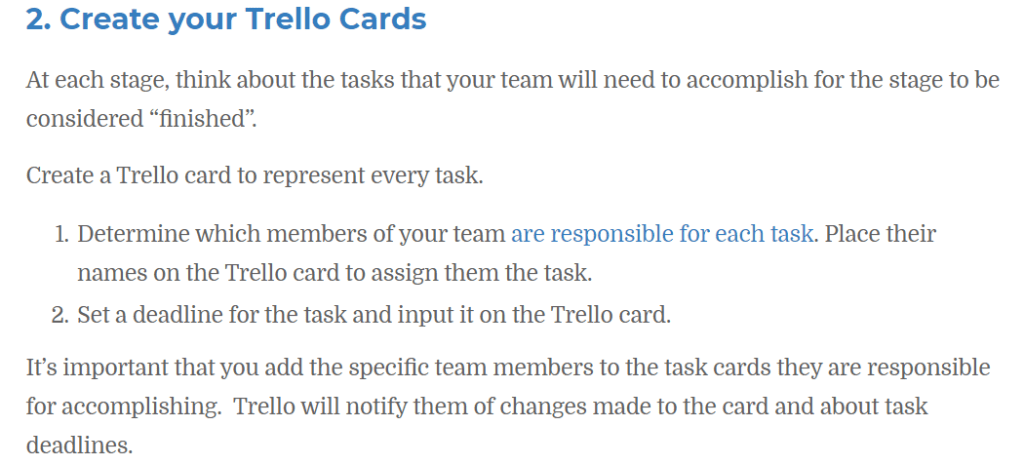
    First of all, the structure in the “bad” content shares a skeleton with the “good”, but makes several of the mistakes the structure guide warns of. The content does look good on mobile devices, but is an annoyance to read on desktop with the website’s banner and menu taking up about 20% of the screen. The paragraphs do allow for white space, but perhaps too much. At times, his writing feels sporadic when almost every sentence is a new paragraph.  The same can be said for the visuals he uses, there is no clear reason to why he uses the visuals he does and they do not add anything to his article. The author’s subheadings were present, but did not front load key words. What is most noticeable about this writing is the inconsistency of his format, particularly when it comes to listing.

    This shows the worst example of this where it is unclear why some of his “steps” are numbered and why some are not.

    The “good” article has a much cleaner and understandable format. Her subheadings were clear and effective. The directions she gives are easy to follow since her use of lists is optimal. To enhance understanding, she has plenty of useful visuals. However, the reader could still get by without them.

    In the “good” article, the author uses lists effectively and outlines the works that are most important in bold.

    The differences in structure are dramatic enough, but where the “good” piece is really good is in the style of writing. Even though the content is a simple how-to, the reader feels connected to the writer of the “good” piece because she had good style. According to Zinsser, the more you believe in you identity and opinions the better your writing will be. I was drawn to her content because she wrote like she was an actual human. I felt that she was genuine. On the other hand, the “bad” writing seemed to have no identity. It did its job in a how-to standpoint, but it did not stick out to me. In fact, the only reason I remember this content is because it was a foil of the article that was so memorable to me.

  • Bio: Emma Richardson

    February 9th, 2020

    Stories can push us to feel emotion and empathy for those with whom we share our world. Stories are what connect us to others and inform us on how different people lead their lives – and my goal is to help people share their stories through the art of documentary film.

    My nonfiction projects include a film on a ten-year-old boy’s love for rapping, short films on the issues surrounding members of New Haven’s Mothers and Others for Justice, a film about the road homeless dogs from Louisiana take to find their forever homes, a biography of singer-songwriter-activist Elaine Kolb, and a film on a woman in India who assists girls in local villages.

    In addition to my personal projects, I am a professional assistant editor at Triple Threat TV in Stamford, CT and regularly organize footage and assemble rough cuts for television series. I also do freelance filmography and editing for local businesses and organizations such as Elm Shakespeare Company in New Haven, CT and the River Advocates of South Central CT in which I create promotional videos and record and edit their events and shows.

    I will soon graduate with a BA in Film, Television, and Media Arts from Quinnipiac University and will continue to hone my storytelling and content creation skills by pursuing a MS in Interactive Communications and Media.

  • Creating Art in All the Chaos: Deep Work in Documentary Production

    December 11th, 2019

    In these past few months I have delved into the the issues with modern-day life in regards to productivity and life balance. For my final white paper, I decided to examine how adapting deep work into the field of independent documentary production can allow you to organize your life’s work and make meaningful content to share with the world. I discuss the what, how, when, and why of deep work and end my paper with an interview with Ashley Brandon, a documentary filmmaker and full-time professor. Feel free to download and share.

    richardson_whitepaperDownload
  • We Only Have 24 Every Day. Let’s Make the Most of It.

    December 5th, 2019

    In these past few months, I have been arguing for the utility deep work provides and giving pointers as to how to make time for it. However, even after following what I have been writing, I am still struggling to do deep work consistently. In this week’s readings, I have found that I am neglecting to acknowledge a flaw in my thinking: it is impossible to make time. We have 24 hours each day and seven days a week to live our lives – there is no negotiating that.

    In the year 1910, a philosopher names Arnold Bennett published a book entitled “How to Live on 24 Hours a Day.” Even though this book was published over 100 years ago, we still, in fact, have 24 hours in our day. As the article How to Live on 24 Hours a Day: Arnold Bennett on Living a Meaningful Life Within the Constraints of Time by Farnam Street points out, Bennett’s ideas are still relevant to today and provide a trove of insights that can help us understand how to make the best use of our time, and in turn, the best use of our lives.

    One of Bennett’s first ideas is that our society has a counterintuitive tendency to value money over time. He argues the proverb “time is money” is a foolish way to think, since you can make money with time but you cannot make time no matter how rich you are.

    “We shall never have more time. We have, and have always had, all the time there is.”

    (2017, May). How to live on 24 hours a day: Arnold Bennett on living a meaningful life within the constraints of time. Farnam Street Media Inc. Retrieved from https://fs.blog/2017/05/arnold-bennett-living-meaningful-life/

    Personally, I spend about 28 hours a week working and about 7 hours getting to and from work. That means that every day I spend 5 hours on average on my income. I am also a full-time student and spend about 11 hours in class, or 1.5 hours per day. Add on homework, school projects, and travel and I would say it would be a total of 20 hours a week or about 3 hours a day. So there is 8 hours for school and work, then I assume another 8 for sleep and I am still left with about 8 hours on average of open time. Not so bad…so how do I spend this time?

    Bennett suggests spending at least an hour and a half of it on “cultivating the mind”. His version of this was reading “the work of stoics”. Instead of that, why not use it for Deep Work? An hour and a half every day of productive time would allow us to make large strides in projects in a short amount of time.

    The remaining six and a half hours is up to you. My suggestion is that you simply plan each hour. Bennet says “you can turn over a new leaf every hour if you chose,” so make the most of your time – these are the hours that will allow you to be you. The only thing that I would not advise you do in this time, however, is using you phone mindlessly.

    I have already discussed the damage that constant connection can have on your work and life in previous posts, and in Cal Newport’s third rule of “Deep Work” he gives some guidance onto how we can actually use social media to enhance our time rather than letting it suck it all away.

    Newport notes that many knowledge workers approach the issue of social media use in a rather binary and crude manner by either embracing it wholly or cutting it out all together. He instead suggests that we take “the craftsman approach to tool selection” by identifying the core factors that determine success and happiness in both our personal and work lives then analyze each tool to see if its benefits outweigh its negatives in regards to our core factors. Newport calls this process “Applying the Law of the Vital Few” and breaks it down into four steps:

    1. Identify high-level goals in your personal and professional life.
    2. List 2-3 important activities that help satisfy those goals.
    3. Consider the network tools you currently use and rate them by positive, neutral, or negative impact.
    4. Keep only the tools that have a positive impact.

    He also suggests doing a social media detox (much like the one I wrote about) to test for two things: first, if those days wold have been notably better if you had used social media and second, if people actually cared whether or not you used the service. In reality, you may find that one, your days may have quite improved, and two, that people tend to notice things much less than you think they do.

    By limiting your social media using it with intent, you will become a part of what Newport calls “The Attention Resistance”. In the chapter of “Digital Minimalism” by the same name, Newport urges you to fight against the tools that consider themselves to be “fundamental technologies” as they are simply trying to get (and keep) your attention so they can make an income. He lists a few practices that may help if you are still finding yourself to be carried away by the constant connection.

    • Remove Social Media From Your Phone. The vast majority of time wasted on social media is when accessing it from the device that you keep by your side 24/7. According to Newport, 88% of Facebook’s earnings come from its mobile app. So, if you do not want to completely cut off your far-away friends and relatives and delete all the pictures you have complied, simply delete any apps you still use (but use a little too often) to force yourself to take the extra step and open up you laptop. It is surprising how such a small deterrence can save you so much time.
    • Turn Your Devices Into Single-Purpose Computers. In the olden days of floppy discs, PCs were only able to run a single program at a time. Now, depending on the size of your RAM, the possibilities for multitasking are nearly infinite. To avoid unwanted distraction caused by social media turn your PC into a single-use device. Only have one program open at a time so you are not tempted to simply swipe left or right into another world of distraction.
    • Use Social Media Like a Professional. To use social media wisely, that means you must think carefully about why you engage with it and who you engage with on it. Newport suggest keeping the amount of connections online down to the Dunbar’s Number of about 150 since that is how many people we can actually maintain relationships with. In addition thinking carefully about who you engage with, try not to use social media as a tool for entertainment. When it comes down to it, you will barley remember any of the content you see and there are much better options for how to spend your time.
    • Embrace Slow Media. Now that you are using social media only to keep tabs on close family and friends, it is time to find where to receive your information from. According to Newport, the best way to do this it to find a small group of authors or content creators who you trust and read their content primarily. However, he also suggests that you seek out arguments against your own as to not get trapped in a vacuum of repetitive (and potentially misguided) information – something that is very easy to do if you get your information for your friends and family on Facebook.
    • Dumb Down Your Smartphone. If none of these practices seem to work for you, it is time to take the next step. Save yourself time and money and go back to a flip-phone. If you need to access the internet, it is likely that you have a laptop with you anyway. Yes, it will be annoying to learn how to text using the number pad again, but the time you save by saving yourself from instant access to social networks can be life-changing. However, there is no need to do this if your smartphone is not enough of a problem and you are able to apply the rest of the practices with ease.

    This is a lot to take on at once, especially since we have grown so reliant on the convenience of today’s tech. If you make mistakes or cheat every once and a while, don’t be too hard on yourself. As Arnold Bennett says:

    “Be content with quite a little. Allow for accidents. Allow for human nature…especially your own…a glorious failure is better than a petty success.”

    (2017, May). How to live on 24 hours a day: Arnold Bennett on living a meaningful life within the constraints of time. Farnam Street Media Inc. Retrieved from https://fs.blog/2017/05/arnold-bennett-living-meaningful-life/

    At the very least be mindful of how you use your days. I am still very young, but have come to realize that time is moving faster and faster and the time I have for myself is less and less. So when I do have time for myself, I will use that time to strive for the goals I have for myself. Bennett implores you to strive for your goals because even if you do not reach them, you will be more fulfilled than those who never even tried.

←Previous Page
1 … 6 7 8 9
Next Page→

Blog at WordPress.com.


Loading Comments...
 

    • Subscribe Subscribed
      • Emma Lao
      • Join 57 other subscribers
      • Already have a WordPress.com account? Log in now.
      • Emma Lao
      • Subscribe Subscribed
      • Sign up
      • Log in
      • Report this content
      • View site in Reader
      • Manage subscriptions
      • Collapse this bar