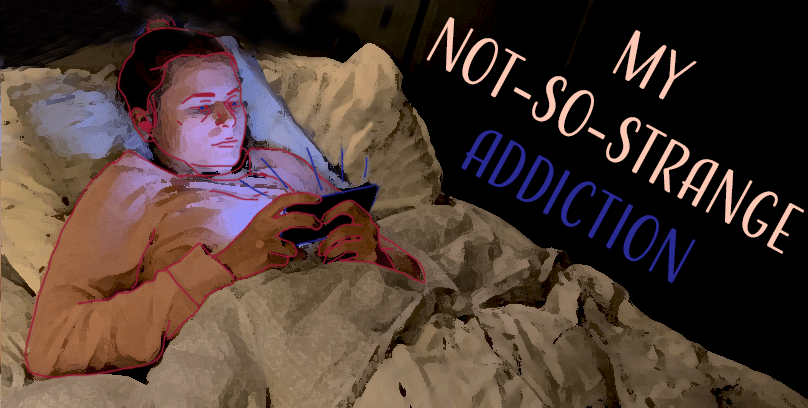
I have an addiction.
This week’s assignment for class was to give up some sort of distraction in our lives – do a “digital detox”. Knowing that YouTube is my main source of entertainment (and procrastination) I decided to give it up for seven days. I did not realize how much of a distraction it was until the first day of my detox when I decided to look at my YouTube history for the previous week and calculate the total minutes watched.
It came out to 1549 minutes. That is over a day of time spent on YouTube! While I was sick and in bed for a few of those days, even the days I was healthy I was spending up to three hours watching videos that, as I came to realize when studying my history, where not particularly interesting.
This addiction is not something that I am alone in. In Domingo Cullen’s article YouTube Addiction: Binge Watching Videos Became My ‘Drug of Choice’ he talks about how a simple bad habit of watching YouTube videos for a good chunk of his weekend turned into an all-out addiction that affected his work and social life. He found that watching these videos did not even bring him joy or “improve his life in any way,” but simply served as something to do in a world that encourages doing things constantly.
“To be addicted it to be completely at the whim of your impulses.”
Cullen, D. (2019, May 3). YouTube addiction: binge watching videos became my ‘drug of
choice’. The Guardian. Retrieved from https://www.theguardian.com/us-news/2019/may/03/youtube-addiction-mental-health
Like Cullen, I used YouTube out of habit – the second I felt any sort of silence or boredom, I quickly settled for a video that would at least serve as background noise. I was not doing this action deliberately, rather as a wanton who is afraid to slow down and face the silence.
It is unfortunate that this is how I handle such a useful tool, since there can be much to learn from digital content. Hossein Derakhshan’s article The Web We Have to Save outlines a major shift that has happened in the way the internet is used and how we consume information. He found that after being away from the internet for six years he had to completely change his approach to how he wrote and presented himself to be at all relevant in today’s social-media centrist internet. He could no long simply write and share information, he had to give in to the norm of today’s media standards by being active on social media and giving into the “stream” that controls what every single person on the internet sees. Most disturbingly, he found that we are departing from a book-based internet to a television-based one.
There is of course nothing wring with (a healthy amount of) television, but when the line between information and entertainment is that blurred, dangerous things can happen. In my case, I am misusing YouTube in both an educational and entertainment-filled aspect. Since I am typically watching videos because it is simply something to fill the silence, I do not deliberately seek it out for quality entertainment or for valuable information.
One case of a video that I did end up watching with purpose was Matt D’Avella’s 4 Rules for Digital Minimalism. In this video he did a seven-day detox that followed four rules: (1) no screens in bed, (2) all email once daily, (3) social media limited to 30 minutes a day, and (4) limit all streaming to one day. During this experiment, he found himself in a state of discomfort without access to passive entertainment. He had to get creative with how he spent his time and would sometimes simply have to spend his time doing nothing. However, he found that he was much more productive with his work and was glad to experience the nothingness that many of us miss out on in modern life.
Funny enough, this video was an example of our week’s assignment. Inspired by one of my favorite content creator’s video and in the hopes of finding some sort of explanation for my feeling of constant overwhelm by work and school, I decided to go into the depths of discomfort. I would quit YouTube, Reddit, and using my phone in bed at all.

Coming out of this experiment, I felt enlightened. What was most shocking of all was that when I started watching YouTube again, I found that I did not really miss it. I have no desire to watch or listen to videos as I am trying to do other work. I am now comfortable with the silence and realize I will only be distracted and not gain anything by watching. With my use of YouTube in the future, I will be much more deliberate to not only make more time in my schedule, but to make the act of giving attention to it more special. In doing so, it will make the attention I gave all of my work more special too.
In Chapter Three of Cal Newport’s Deep Work, he discusses how science writer Winifred Gallagher discovered how to live her best life after being diagnosed with late-stage cancer: she simply chooses to pay attention to what really matters to her and makes her happy rather than dwelling on things she cannot know or control.
I often find myself doing exactly the opposite: I am always thinking about what I could be doing, how I could be improving, what I am doing wrong. In these times, I get stressed. During my detox when I was stressed was when I missed my access to mindless entertainment most. I use it as my distraction – I am not choosing to watch videos or scroll on my phone because I think it will improve my life, I am doing it because I do not know how to manage my thoughts when my thoughts are all that is there.
“‘The idle mind is the devil’s workshop’…when you lose focus, your mind tends to fix on what could be wrong with your life instead of what’s right.”
Newport, C. (2016). Deep work (pp. 82). London: Piatkus.
That is why I have created rules for myself going onward – I want to force myself to have those uncomfortable silences and to do each action with more meaning and attention to it so that I can appreciate it for what it is. While I feel overwhelmed by school and work, I actually love doing both. If I can simply spend more time paying attention to what I am doing instead of fearing for what is next, I know that I will feel better like I did during my detox week. I will do my best to overcome my addiction.
Unfortunately, my addiction is something that is not-so-strange for many people in my generation who have access to the internet constantly. As Cullen points out in his article, eating addictions are difficult because “the lion is let out of its cage” three times a day, but “when most of our time is spent looking at screens, internet addiction means the lion never has a cage to begin with.”
This large amount of time looking at our screens has proven to be detrimental to my generation in a multitude of ways. In the article Have Smartphones Destroyed a Generation, Jean Twenge lays out data that points to concerning trends. Those in younger generations who use their smartphone more than the average amount of time are lonelier, unhappier, and more mentally unhealthy. Kids are much more dependent and childhood has extended well into high school, with the rates of teens driving, having part-time jobs, and dating going down rapidly since the 90’s.
While I did have a part-time job, drive, and dated in high school, I felt and still feel like I do not have enough time for everything because I spend so much of it on mindless entertainment. When there is so much stuff filling up my time and my use of the internet on top of that, I feel like I am drowning.
I also relate to those teens Twenge discusses who do not get enough sleep at night. In an the article Why Electronics May Stimulate You Before Bed, the National Sleep Foundation outlines that the use of electronics before bed delays the body’s internal clock, suppresses the release of the sleep hormone melatonin, and makes it more difficult to fall asleep due to the short-wavelength blue light that electronics emanate. This is troubling because this causes a delay for the onset of REM sleep and reduces the overall amount of REM sleep a person gets which can lead to a chronic sleep deficiency.
This may be why when I did my detox and read instead of using my phone in bed before sleeping I had vivid dreams almost every night and my sleep quality raised by a small but significant amount. I also woke up feeling more rested, and in turn started the day more optimistic and energetic. Because of these changes I experienced in that week, I will continue to ban in-bed phone use for myself.
It will be hard to un-do these habits that I have been doing ever since I bought my first iPod touch in eighth grade, but going cold turkey was made me realize how truly beneficial can be. I also want to be a person who acts on what they preach – when I have children, I will limit their screen time in an attempt to avoid the negative side effects outlined in Twenge’s article. If I am unable to limit my own screen time as an adult, how can I force my kids to?
I am tired of giving into the whims of my impulses. I am tired of being unfocused. I am ready to be more deliberate with my actions so that I can live a better and less distracted life.
 Emma Lao
2 responses to “My Not-So-Strange Addiction and What Happened When I Went Cold Turkey”
I really liked the self-reflection you mention throughout the blog. I like the reference of Cal Newport’s book and how you used that story to relate it to your life to focus on self-reflection rather than being stressed out. It seems like you’re focusing on a lot on trying to do better work & improve your life with removing yourself from technology and I like the honesty you put in your post about how you did struggle at times with this project. Doing something cold turkey is an incredibly difficult challenge to do and it seems like you were able to pull it off and find other alternatives to the social media addiction. YouTube is a big app that I use too when trying to relax and I realize now that I also use it to try and get rid of the quiet moments; but sometimes we need those moments to reflect and work on what we can be doing better, and I see that through your blog post that you are continuing to do that after this experiment and working on doing more to better yourself, which I think is really insightful and can help other people who want to end their social media addiction.
LikeLike
[…] also suggests doing a social media detox (much like the one I wrote about) to test for two things: first, if those days wold have been notably better if you had used social […]
LikeLike