In these past few months, I have been arguing for the utility deep work provides and giving pointers as to how to make time for it. However, even after following what I have been writing, I am still struggling to do deep work consistently. In this week’s readings, I have found that I am neglecting to acknowledge a flaw in my thinking: it is impossible to make time. We have 24 hours each day and seven days a week to live our lives – there is no negotiating that.
In the year 1910, a philosopher names Arnold Bennett published a book entitled “How to Live on 24 Hours a Day.” Even though this book was published over 100 years ago, we still, in fact, have 24 hours in our day. As the article How to Live on 24 Hours a Day: Arnold Bennett on Living a Meaningful Life Within the Constraints of Time by Farnam Street points out, Bennett’s ideas are still relevant to today and provide a trove of insights that can help us understand how to make the best use of our time, and in turn, the best use of our lives.
One of Bennett’s first ideas is that our society has a counterintuitive tendency to value money over time. He argues the proverb “time is money” is a foolish way to think, since you can make money with time but you cannot make time no matter how rich you are.
“We shall never have more time. We have, and have always had, all the time there is.”
(2017, May). How to live on 24 hours a day: Arnold Bennett on living a meaningful life within the constraints of time. Farnam Street Media Inc. Retrieved from https://fs.blog/2017/05/arnold-bennett-living-meaningful-life/
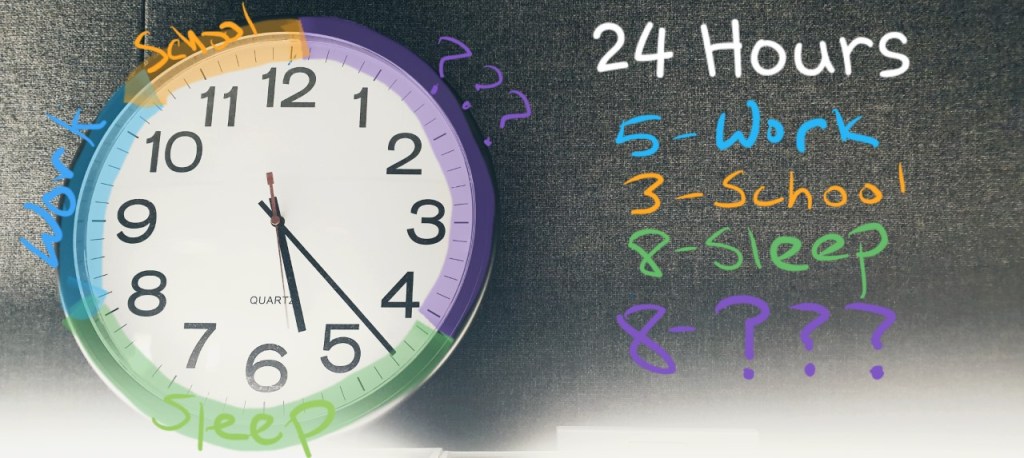
Personally, I spend about 28 hours a week working and about 7 hours getting to and from work. That means that every day I spend 5 hours on average on my income. I am also a full-time student and spend about 11 hours in class, or 1.5 hours per day. Add on homework, school projects, and travel and I would say it would be a total of 20 hours a week or about 3 hours a day. So there is 8 hours for school and work, then I assume another 8 for sleep and I am still left with about 8 hours on average of open time. Not so bad…so how do I spend this time?
Bennett suggests spending at least an hour and a half of it on “cultivating the mind”. His version of this was reading “the work of stoics”. Instead of that, why not use it for Deep Work? An hour and a half every day of productive time would allow us to make large strides in projects in a short amount of time.
The remaining six and a half hours is up to you. My suggestion is that you simply plan each hour. Bennet says “you can turn over a new leaf every hour if you chose,” so make the most of your time – these are the hours that will allow you to be you. The only thing that I would not advise you do in this time, however, is using you phone mindlessly.
I have already discussed the damage that constant connection can have on your work and life in previous posts, and in Cal Newport’s third rule of “Deep Work” he gives some guidance onto how we can actually use social media to enhance our time rather than letting it suck it all away.
Newport notes that many knowledge workers approach the issue of social media use in a rather binary and crude manner by either embracing it wholly or cutting it out all together. He instead suggests that we take “the craftsman approach to tool selection” by identifying the core factors that determine success and happiness in both our personal and work lives then analyze each tool to see if its benefits outweigh its negatives in regards to our core factors. Newport calls this process “Applying the Law of the Vital Few” and breaks it down into four steps:
- Identify high-level goals in your personal and professional life.
- List 2-3 important activities that help satisfy those goals.
- Consider the network tools you currently use and rate them by positive, neutral, or negative impact.
- Keep only the tools that have a positive impact.
He also suggests doing a social media detox (much like the one I wrote about) to test for two things: first, if those days wold have been notably better if you had used social media and second, if people actually cared whether or not you used the service. In reality, you may find that one, your days may have quite improved, and two, that people tend to notice things much less than you think they do.
By limiting your social media using it with intent, you will become a part of what Newport calls “The Attention Resistance”. In the chapter of “Digital Minimalism” by the same name, Newport urges you to fight against the tools that consider themselves to be “fundamental technologies” as they are simply trying to get (and keep) your attention so they can make an income. He lists a few practices that may help if you are still finding yourself to be carried away by the constant connection.
- Remove Social Media From Your Phone. The vast majority of time wasted on social media is when accessing it from the device that you keep by your side 24/7. According to Newport, 88% of Facebook’s earnings come from its mobile app. So, if you do not want to completely cut off your far-away friends and relatives and delete all the pictures you have complied, simply delete any apps you still use (but use a little too often) to force yourself to take the extra step and open up you laptop. It is surprising how such a small deterrence can save you so much time.
- Turn Your Devices Into Single-Purpose Computers. In the olden days of floppy discs, PCs were only able to run a single program at a time. Now, depending on the size of your RAM, the possibilities for multitasking are nearly infinite. To avoid unwanted distraction caused by social media turn your PC into a single-use device. Only have one program open at a time so you are not tempted to simply swipe left or right into another world of distraction.
- Use Social Media Like a Professional. To use social media wisely, that means you must think carefully about why you engage with it and who you engage with on it. Newport suggest keeping the amount of connections online down to the Dunbar’s Number of about 150 since that is how many people we can actually maintain relationships with. In addition thinking carefully about who you engage with, try not to use social media as a tool for entertainment. When it comes down to it, you will barley remember any of the content you see and there are much better options for how to spend your time.
- Embrace Slow Media. Now that you are using social media only to keep tabs on close family and friends, it is time to find where to receive your information from. According to Newport, the best way to do this it to find a small group of authors or content creators who you trust and read their content primarily. However, he also suggests that you seek out arguments against your own as to not get trapped in a vacuum of repetitive (and potentially misguided) information – something that is very easy to do if you get your information for your friends and family on Facebook.
- Dumb Down Your Smartphone. If none of these practices seem to work for you, it is time to take the next step. Save yourself time and money and go back to a flip-phone. If you need to access the internet, it is likely that you have a laptop with you anyway. Yes, it will be annoying to learn how to text using the number pad again, but the time you save by saving yourself from instant access to social networks can be life-changing. However, there is no need to do this if your smartphone is not enough of a problem and you are able to apply the rest of the practices with ease.
This is a lot to take on at once, especially since we have grown so reliant on the convenience of today’s tech. If you make mistakes or cheat every once and a while, don’t be too hard on yourself. As Arnold Bennett says:
“Be content with quite a little. Allow for accidents. Allow for human nature…especially your own…a glorious failure is better than a petty success.”
(2017, May). How to live on 24 hours a day: Arnold Bennett on living a meaningful life within the constraints of time. Farnam Street Media Inc. Retrieved from https://fs.blog/2017/05/arnold-bennett-living-meaningful-life/
At the very least be mindful of how you use your days. I am still very young, but have come to realize that time is moving faster and faster and the time I have for myself is less and less. So when I do have time for myself, I will use that time to strive for the goals I have for myself. Bennett implores you to strive for your goals because even if you do not reach them, you will be more fulfilled than those who never even tried.
 Emma Lao
One response to “We Only Have 24 Every Day. Let’s Make the Most of It.”
[…] We only have 24 hours in the day, so we must make the most of it. Many people make the mistake of seeing the eight or nine hours they spend at work as the day and the time before and after it as bookends when we have nine more hours of conscious time to do with as we please. […]
LikeLike