Visual design relies on evoking an emotion from the audience to share a story or an idea. There are design principles that help artists and designers express certain emotions such as the Gestalt Principles, contrast, color theory, and many more. Designers often follow Plutchik’s Wheel of Emotions to understand the eight basic emotions, their variations, and their combinations so that they can better utilize those principles to express the emotion they want. See my previous posts exploring emotion in images here and here.
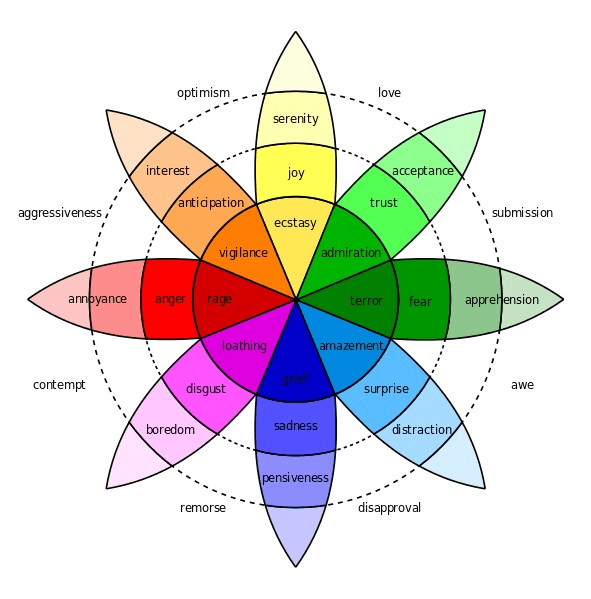
Sometimes, though, artists will express one emotion through their design, but evoke another within the viewer. In the follow examples I will show one image where this was done intentionally for the sake of contrast and another where it is done naturally.
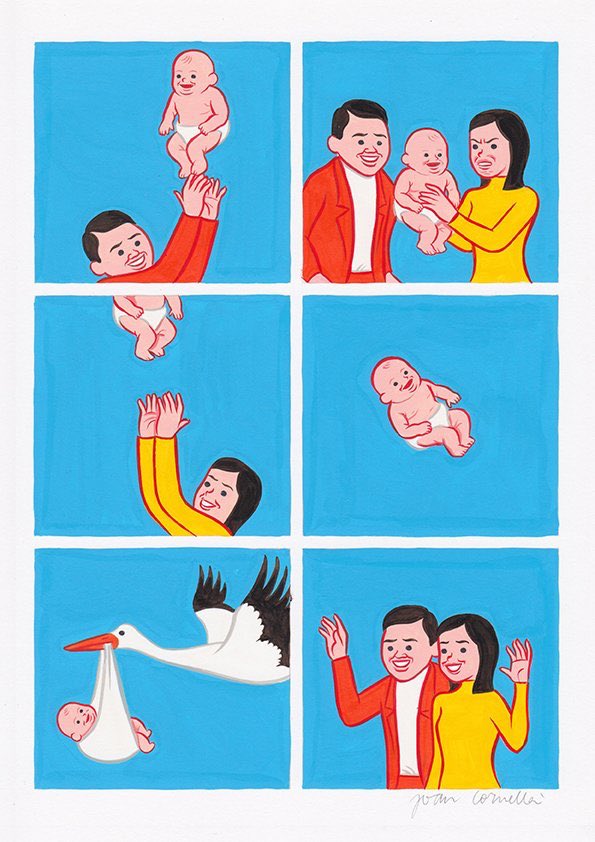
Joan Cornella is a Spanish artist who has become famous for his many satirical comics and illustrations. In all of his images the characters adorn a permanently-happy face and are also very bright and colorful. Both of these aspects point towards the emotion of joy. However, the subject matter of his drawings are almost always cynical, violent, or shocking. This comic is one of his more bizarre ones – you see a couple tossing their baby in the air, the mothers’ disgusted look, then the baby being tossed all the way up to the sky where the pelican takes it away. Even though that situation is horrific, everyone (including the tossed baby) is happy about it (at least on the outside).

Much of his work has to do with the idea of “fakeness” and discontent with life. The fact that the colors are so bright and the characters appear to be so happy initially evokes a bright, pleasant emotion to the viewer, but after actually seeing what the images portray it is apparent that there is a conflict between the image’s message and the design elements that express emotion. This conflict works perfectly to push Cornella’s idea that even though people put on a happy face, they are usually empty or simply messed-up on the inside.
The next image is a photo taken at a court ruling. The emotion that this image is evoking is full of grief – the defendant has his head down to the table, his lawyers are crying or trying to comfort him, and you can see from the muscles on his head that he is crying. As explained in the psychology of sensation and perception, humans are able to look at an image and process the information in milliseconds then make an implicit assumption based on that information. From the context of the situation – a courtroom, the emotions on their faces, the defeated position, a viewer would assume that the emotion this image is grief.
While the visual context is expressing grief, the textual context tells a completely different story. This man is actually crying from joy. Brian Banks was falsely accused of rape, causing him to serve a prison sentence for five years. After a taped confession from the woman accusing him came out, he was released. This image is capturing the moment that the judge made the decision to make him a free man again – and with that information the emotion which is evoked is completely changed.
Both of these examples show the importance of distinguishing between expressing emotion and evoking emotion. While the design of an image may express a certain emotion, the emotion that is actually evoked can be completely different depending on its content.
Annenberg Learner. “Discovering Psychology: Updated Edition – Sensation and Perception” WGBH Educational Foundation, Feb. 2001, https://www.learner.org/series/discovering-psychology/sensation-and-perception/.
Busche, Laura. “Simplicity, symmetry and more: Gestalt theory and the design principles it gave birth to.” Canva, https://www.canva.com/learn/gestalt-theory/. Accessed 4 Sept. 2020.
Cao, Jerry. “Web design color theory: how to create the right emotions with color in web design.” The Next Web, 7 April 2015, https://thenextweb.com/dd/2015/04/07/how-to-create-the-right-emotions-with-color-in-web-design/. Accessed 4 Sept. 2020.
“Putting Some Emotion into Your Design – Plutchik’s Wheel of Emotions.” Interaction Design Foundation, 2020, https://www.interaction-design.org/literature/article/putting-some-emotion-into-your-design-plutchik-s-wheel-of-emotions. Accessed 4 Sept. 2020.
Walter, Aarron. “Designing For Emotion (Aarron Walter).” YouTube, April 12 2012, https://www.youtube.com/watch?time_continue=1&v=ks91vBm3oT8&feature=emb_logo.
 Emma Lao