In this presentation I explain the social media strategy that Fern’s Meadow will undertake to achieve the goal of increasing engagement and brand awareness. This includes a social media audit, branding and audience engagement plans, the identification of SMART goals, the voice of the brand, sample posts, and key metrics that will be tracked.
Category: Social Media Strategy
-
Watch the presentation here or download the slides below. -
Community Guidelines
Fern’s Meadow is a small family hobby farm and we strive to share our family’s love for local produce, home cooking, and (of course) animals through our social media channels. We view many of our close friends and biggest fans as a part of the Fern’s Meadow family and are overjoyed when the community engages with us and each other.
That said, we would like to set a few guidelines for this community to ensure that our page stays in line with our family and farm’s values:
- Please do not post offensive or vulgar material via comments, posts, photos, ect.
- Please be respectful of other members of the Fern’s Meadow community.
- Please stay positive – we are all here to have fun and enjoy the loveliness that home-grown produce and farm animals add to our lives, so let’s stay focused on the good in life!
We have yet to come into these issues, but if any of these rules are violated we reserve the right to delete comments or even ban users if there are multiple offenses.
We welcome posts and reviews about your experience with us, as well as comments on what you think about our posts and products. We are sincerely interested in what you have to add, so please share any input you may have.
Every once and awhile we may post an advertisement for our artisan goods or local produce – all of the above apply to those as well. We hope that you understand that our main goal is to share fresh produce and quality products with as many people as we can, and sponsored content is an excellent way to achieve that.
Thank you so much for being a part of this community, and feel free to contact us with any questions or concerns!
– The Fern’s Meadow Crew
Frequently Asked Questions
You say you are a small family farm, but how small are you?
We are made up of the Richardson family – Dennis (originally from Arkansas), Kristen (originally from Nebraska) and their three daughters Emma, Maggie, and Kate. In 2016 we moved to a 6.5 acre plot of land in Meriden, CT where we upgraded our small garden and chicken coop to a substantial garden, two beehives, more chickens, ducks, and of course our wonderful Nigerian Dwarf Goats.
How many goats do you have? Can you tell me more about them?
We have 5 mama goats and 6 kids. Learn more about them here: https://fernsmeadow.com/nigerian-dwarf-goats
Where can I buy your produce?
We will be at farmer’s markets across central CT once they open up, but for now we are open for pick up. For more info on the produce that is currently available send us a message with your email so we can add you to the email list: https://fernsmeadow.com/contact-us
What kind of artisan products do you make? Where can I get them?
Fern’s Meadow makes handcrafted goat’s milk soap, beeswax balm, CBD infused beeswax balm, lavender saches, and catnip saches. You can either order them from our website (https://fernsmeadow.com/shop) or pick them up at Farmer Joe’s Gardens or Beaumont Farm (both located in Wallingford).
Can I come visit your farm?
While we have yet to set up formal visitations, feel free to contact us if you would like to visit. We hope to plan small events in the future so people can see what we’ve been up to, but for now you will have to catch us at the farmer’s markets. You can also visit us if you schedule a pick up!
Do you have any recipes that use the things you grow in the garden?
We have many that we have crafted over the years and we hope to share them with you over the Summer via our social media and blogs. Stay tuned!
Do you sell your honey? What about your eggs?
Both our honey and eggs are in high demand and we have somewhat of a short supply. Before we go to the farmer’s markets we will post what will be available that day on Facebook. Also, if you join our email list you can come almost anytime in the week to pick up what is available!
Do you have goats for sale?
Every year we breed our Nigerian Dwarfs to sell for milking does, show goats, or wethers (neutered males who make wonderful pets). We currently have 4 does and 1 male for sale. For more information, call us at (203) 889-6248.
Do you sell plants?
This year we are not selling any plants, but we suggest you visit Beaumont Farm or Farmer Joe’s Gardens in Wallingford – and while you are there, check out our artisan goods!
Why should I buy local?
There are too many reasons to say in a simple FAQ, but here is an article that may help you understand the impact you can make by supporting local businesses: https://www.onegreenplanet.org/lifestyle/reasons-to-buy-local/
-
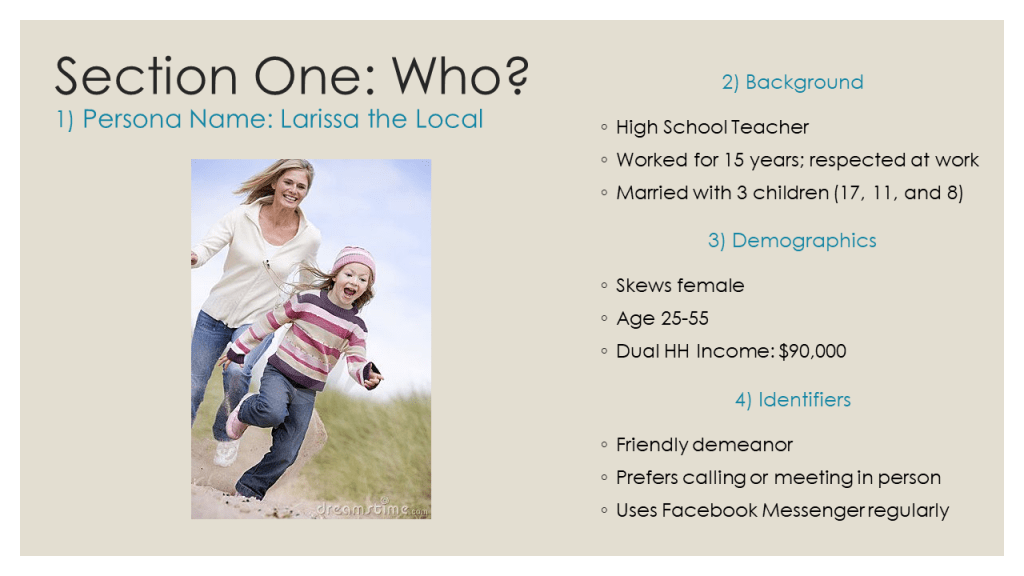
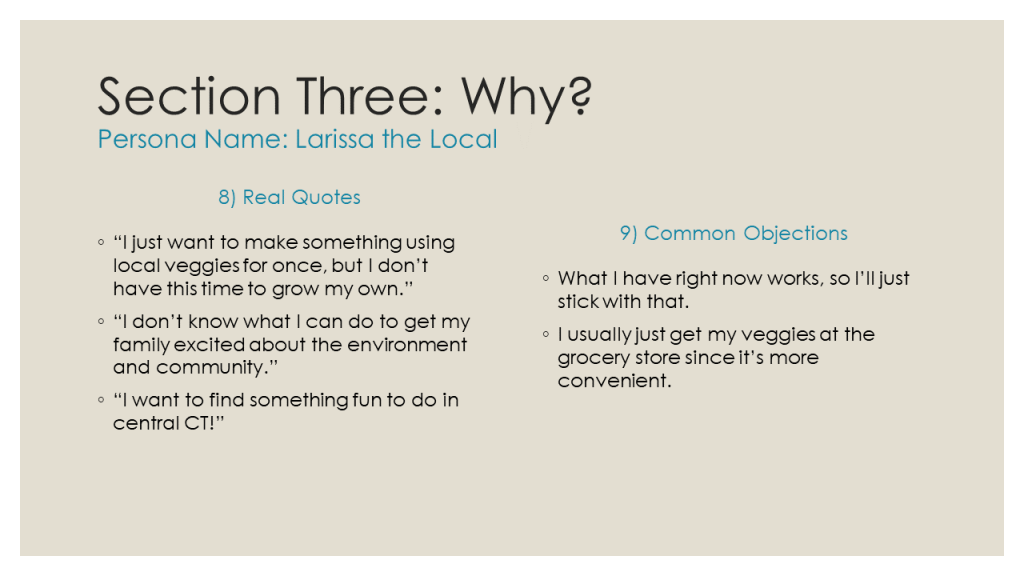
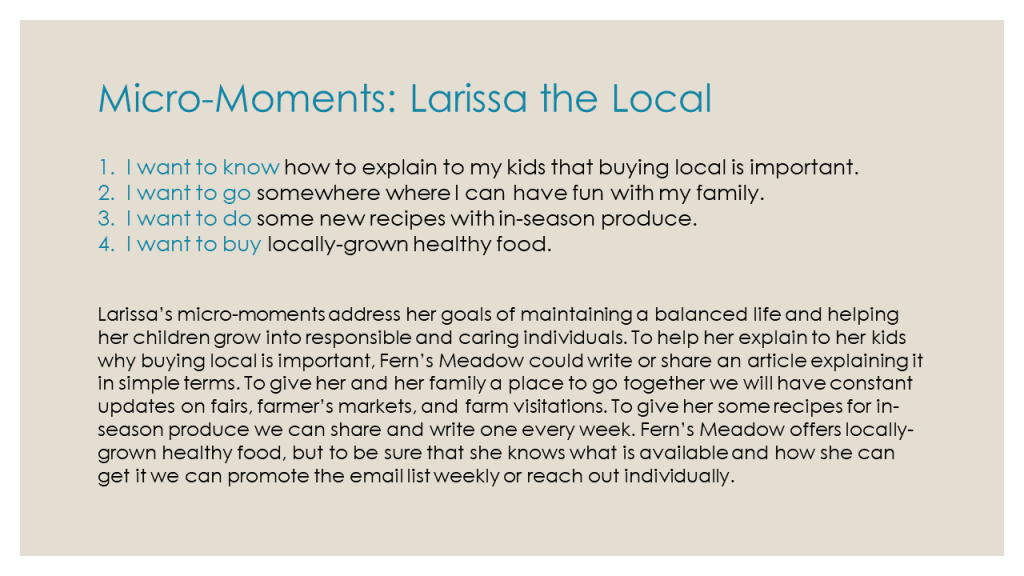
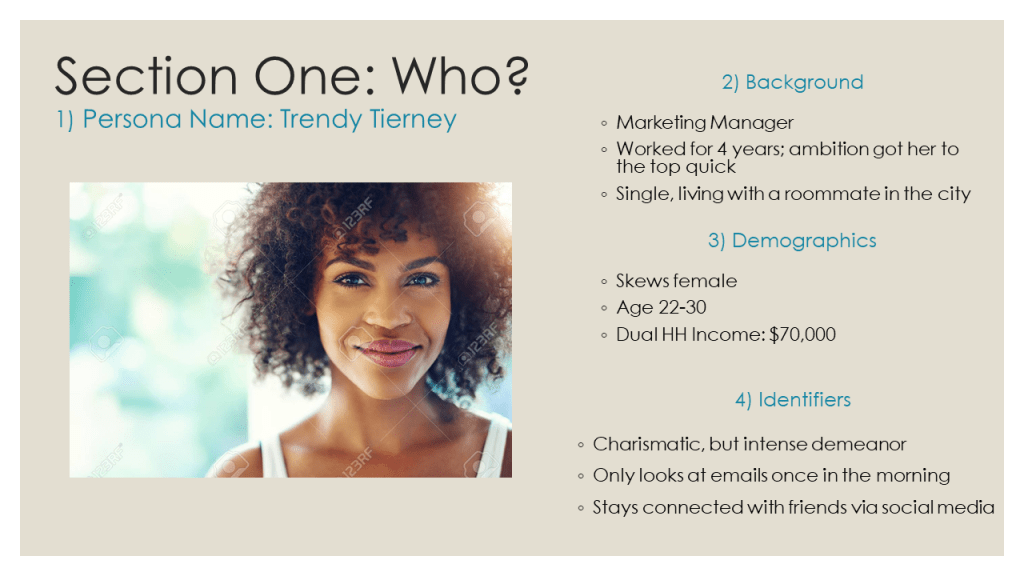
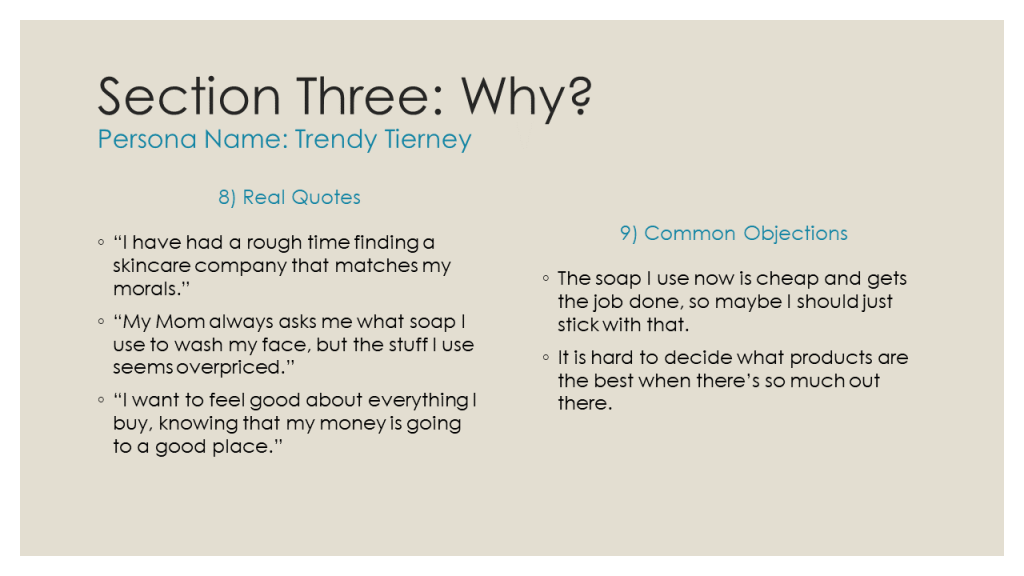
Below is the Power Point that breaks down two personas and their micro-moments for the Fern’s Meadow social strategy.






-
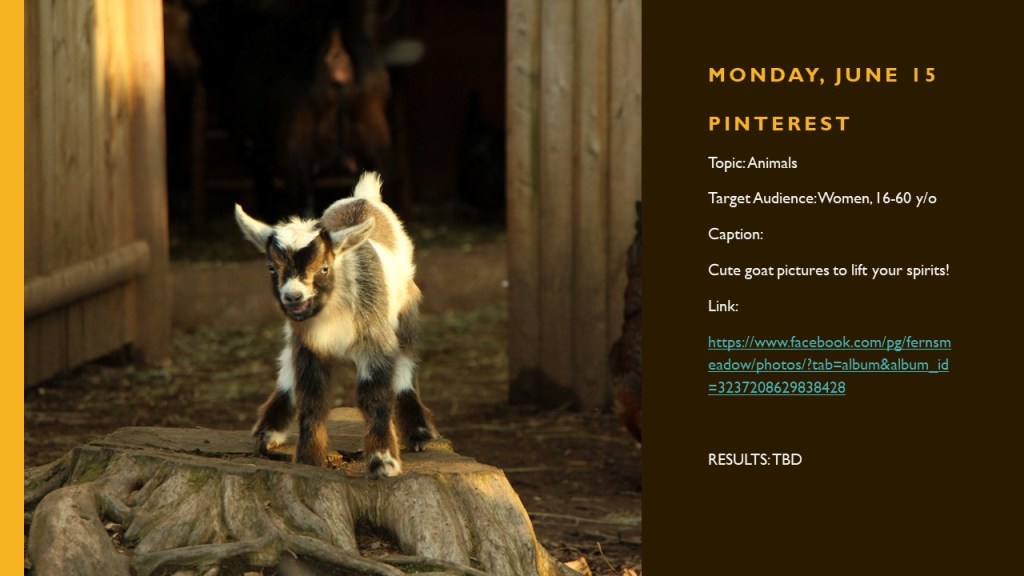
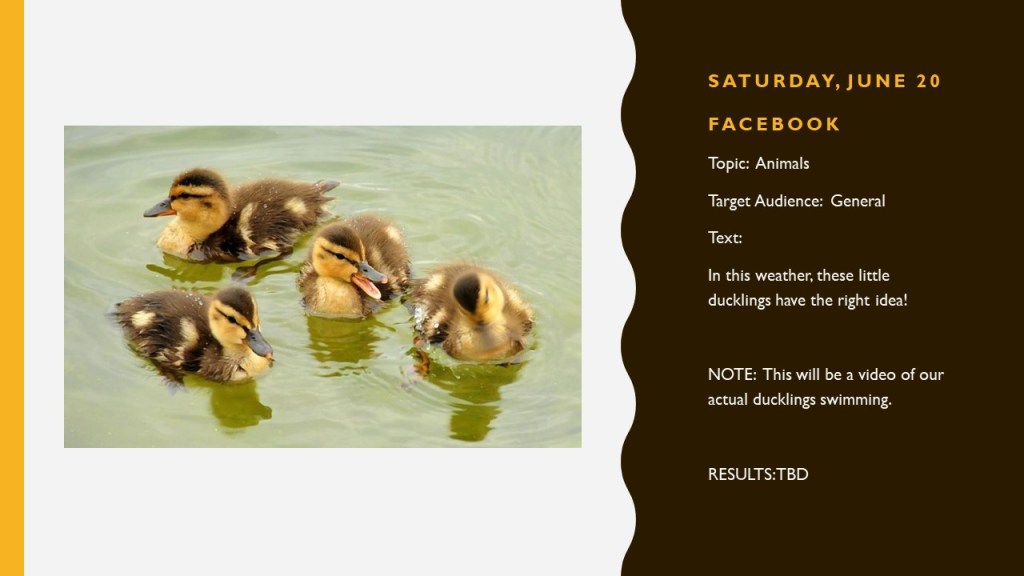
Here is the social media content plan for the upcoming week. The majority of the Facebook posts will be slightly altered and be posted on Instagram as well.





-
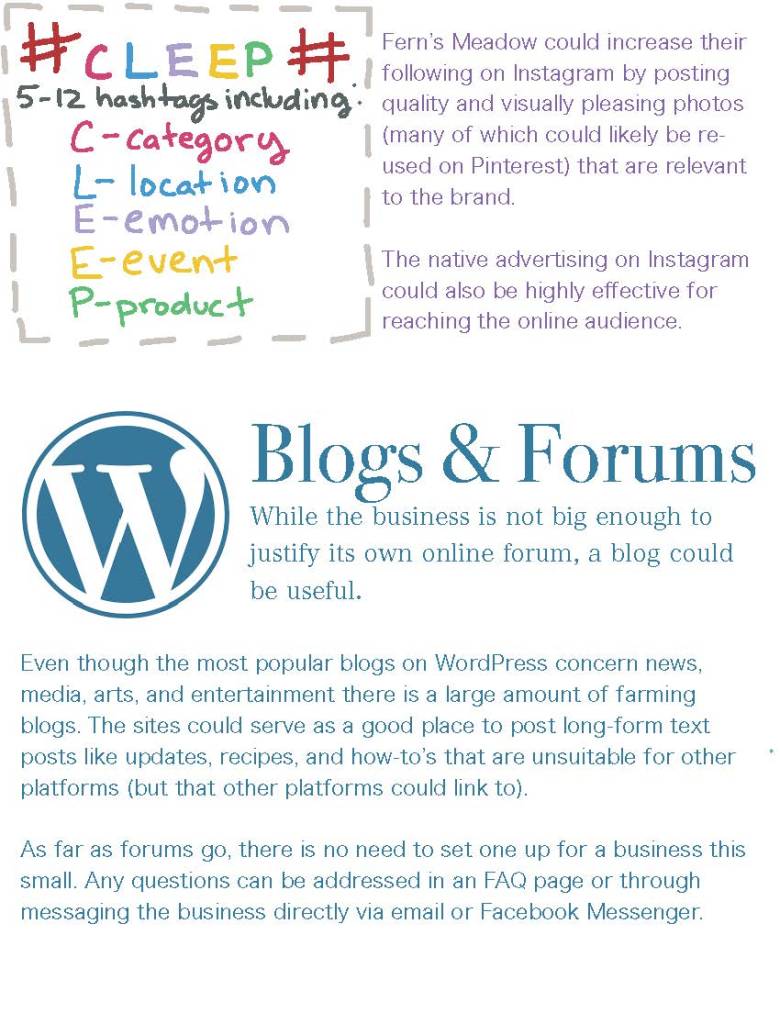
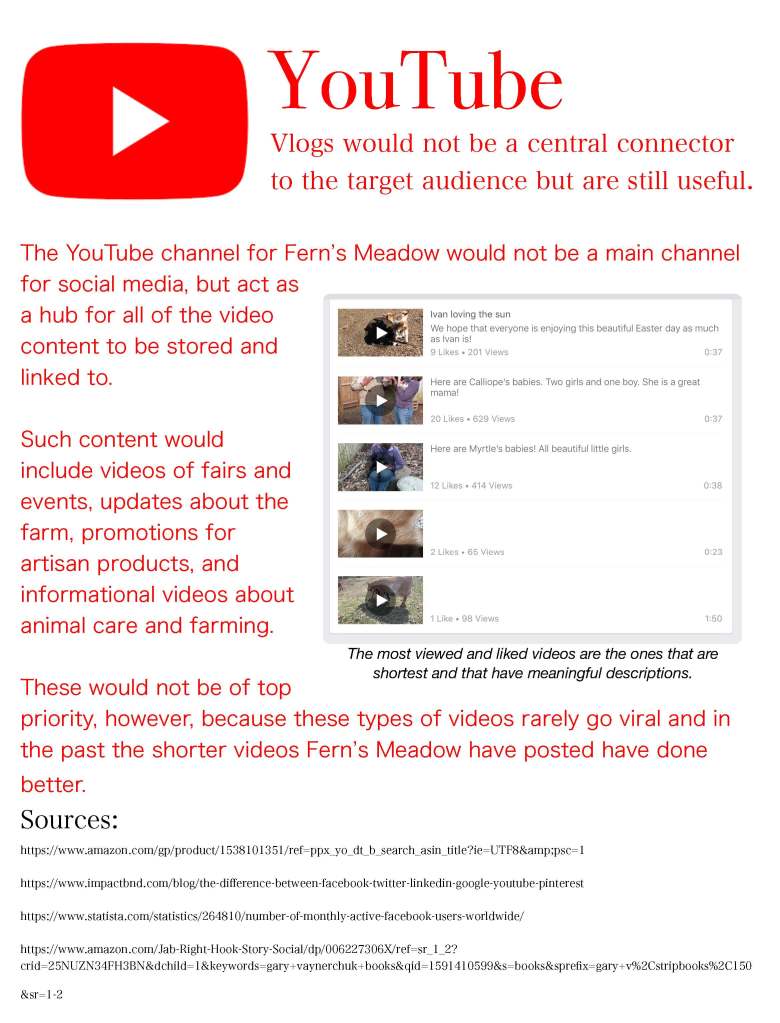
This social plan is based off Parts 7 and 8 of the textbook Social Media Strategy: Marketing, Advertising, and Public Relations in the Consumer Revolution.


-
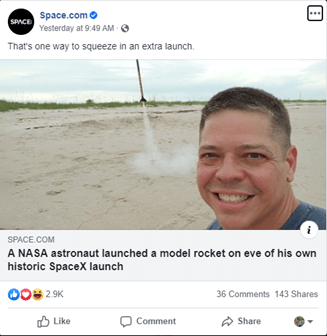
SpaceX partnered with NASA to send two astronauts to the space station on May 27th, 202. There were four main events within this SpaceX Launch that news sites covered on social media. First was the hype about the announcement of the upcoming launch date at the beginning of the week.
On May 27, @AstroBehnken & @Astro_Doug will ride atop this @SpaceX rocket to the @Space_Station, marking the first time humans have launched from U.S. soil since 2011.
— NASA's Kennedy Space Center (@NASAKennedy) May 24, 2020
Weather is 40% go for launch at 4:33 p.m. ET and live coverage begins at 12:15 p.m. ET: https://t.co/d1YYeACVXw pic.twitter.com/txhoP4Ay6aFalcon 9 and Crew Dragon will lift off from Launch Complex 39A – the same place Saturn V launched humanity to the Moon and from where the first and final Space Shuttle missions lifted off pic.twitter.com/wOSsbCRqi7
— SpaceX (@SpaceX) May 25, 2020This article had 840 shares on Facebook. 1961: First human in space
— Lex Fridman (@lexfridman) May 26, 2020
1969: First human on the moon
2000: First human long-term stay aboard the ISS
2020: First SpaceX flight with humans on-board
Tomorrow (May 27) a new chapter of human space exploration begins.
Good Luck and Godspeed to @elonmusk, @SpaceX & @NASA teams.The SpaceX Crew Dragon capsule will be the first private spacecraft to take NASA astronauts to orbit. Check out this tour Elon Musk gave me in 2014 when it was just a baby Dragon! #allgrownup #Demo2 pic.twitter.com/49zQgxHHgt
— Rachael Joy Nail (@Rachael_Joy) May 26, 2020Have any questions about tomorrow's #SpaceX launch? Science writer @nadiamdrake is on the ground with the latest on the Demo-2 mission! Reply below and stay tuned for her answers beginning at 5pm ET https://t.co/LznPghXAOk
— National Geographic (@NatGeo) May 26, 2020"This is a dream come true, I think for me, and everyone at @SpaceX." @ElonMusk is ready to #LaunchAmerica: pic.twitter.com/xgScFca9eY
— NASA (@NASA) May 27, 2020The social media response was mostly positive and the most popular articles were credible and factual. Then on May 27th the launch was postponed due to bad weather conditions.
This is when political posts began to appear, something that was not common beforehand.
“Trump is bad luck,” a SpaceX employee told a reporter. #PatriotsWearAMask
— Scott Dworkin (@funder) May 28, 2020Scott Dworkin is the co-founder of the Democratic Coalition. There is no source to this quote. The next day, people began to poke fun at the situation as they prepared for the new date.
Historic SpaceX Launch Postponed https://t.co/6JwUJq8G6H #WhatDoYouThink? pic.twitter.com/lGROxGFiLo
— The Onion (@TheOnion) May 28, 2020Just so you know, The Onion is a parody site – self-admitted fake news. Then on Friday, May 29 a SpaceX prototype rocket exploded at a Texas launch space. Even though the rocket was a completely different model than the one going to space the next day, the timing was just right to make people alarmed about the safety of the astronauts and brought up political issues with SpaceX.
Just a note – the user who retweeted this makes mostly political tweets. Of the 33 that I read (all from Friday or the day before) only 2 were neutral or positive. This article’s only source is a quote from a local and the author’s name and profile are of a fictional character. There were still some credible journalists who approached the situation with only facts.
A Starship prototype just exploded in Boca Chica, Texas during static fire testing. SpaceX was granted an FAA license yesterday to conduct suborbital flights, not sure when those first test flights will happen. Video/live feed from @NASASpaceflight pic.twitter.com/dqnQv1lqBV
— Joey Roulette (@joroulette) May 29, 2020An article written by Roulette, a long-time space journalist, can be found here: https://www.reuters.com/article/us-space-exploration-spacex-explosion/prototype-of-new-spacex-rocket-starship-explodes-on-texas-test-pad-idUSKBN235319 SpaceX Starship prototype explodes after engine test firing in Texas https://t.co/vgdGVecvnz
— CBS News (@CBSNews) May 29, 2020There were also many articles being circulated on Facebook. One thing to note is that by far the most shared article was one from TMZ which was published only 34 minutes after the explosion. The rest of the articles that followed were much less popular even when the page had more followers.
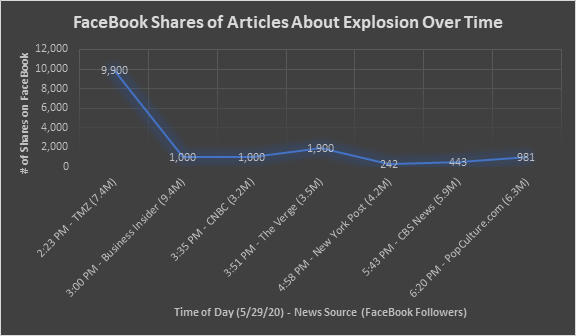
The explosion occurred at 1:49 PM on May 29, 2020. The numbers were gathered via Facebook at 4 PM on May 30, 2020. This phenomenon is something that is not new to social media – journalists are forced to act fast or miss out on a huge opportunity. In Ryan Morris’ case study on breaking news in social media he found that a similar article from two sources with a following about equal to each other had a difference of 360 vs 197 shares just because one posted nine minutes earlier. The next big news outlet to cover the explosion after TMZ was Business Insider, and even though they have 2 million more followers on Facebook, they had 8,900 less shares.
The Business Insider article was through, factual, and clear while the TMZ article itself had no mention of sources and was mostly speculation. It also had a misleading title that would lead people who only read the headline to believe the rocket that exploded could be the one that was supposed to carry the astronauts to the space station on Saturday – there is no clarification in the article for those who are not well-informed about the launch that it is a different rocket. This especially troubling since according to Nicole Martin’s article “How Social Media Has Changed How We Consume News” the average read time of online content is 15 seconds. Meanwhile, Business Insider laid out all of the facts right at the top of their article in a quick and easy-to-read format which can easily be understood in 15 seconds. Still, the TMZ article was first and therefore the most shared.
Finally on Saturday, May 30th the Crew Dragon successfully launched and the coverage was mostly factual and positive again. The launch was also the only non-political and positive trend on Twitter.

Liftoff! pic.twitter.com/DRBfdUM7JA
— SpaceX (@SpaceX) May 30, 2020It is interesting to see how when everything was going according to plan the popular articles were considerably more credible than the ones that happened during the chaos of the explosion. When the explosion happened posts were much more opinion-based, emotional, and full of speculation.
The immediacy of social media can be to blame for the lack of facts and amount of rumors in some of the articles that were posted in response to the explosion. However, social media also had a positive effect on the story by sharing live footage of the launch – an event that many people were excited to tune into.

Facebook had more posts of information about the launch and where to watch live while Twitter had more posts of people’s reactions to the event. It was also a lot easier to find opinionated and political posts about the launch on Twitter – many were even liked and retweeted quite a bit. It was difficult for me to find those kinds of posts on Facebook since my personal circle does not make posts like that.
I feel that the best way to learn about the launch is to read articles from trusted sources and follow official Twitter accounts like @SpaceX and @NASA for direct real-time information. When it comes to some events that are unexpected like the explosion, it is best to wait for a trusted news site to make an article rather than feed into the immediate rumors and speculation.
While I am not typically a user of Twitter, it was interesting to follow the event’s updates in real time. However, the moment I opened Twitter for the project I would become distracted by the opinions of people who I frankly do not care about – so in the future if I do decide to use Twitter again I will be sure to follow only those that I want to hear from. I may even use an app like Stay Focused to be sure that I use the site only for what I intend to so that I cannot mindlessly scroll for hours.
A final takeaway from this case study was how when something goes wrong people news sources are quick to jump onto the story and people are quick to use the failure as a way to spread negativity. Still, it was heartening to see the Tweets made by the majority of people who were excited for the country’s next step in space exploration.
-
Historically, media allowed organizations to spread one message to a mass of people without their voice being heard. The only time the individual was able to participate in media was with other individuals via telegrams or telephones. Until recently, it was difficult for people to share their stories others using media and impossible for communities to collate.
With the emergence of social media, the audience’s role was morphed into an active role of both a consumer and a producer. In Clay Shirky’s TED Talk “How Social Media Can Make History”, he delves into the fact that modern media allows for individuals to convene and support each other as a group. Conversation can now take place between consumers, allowing for information to be transmitted from individual to individual rather than individual (or organization) to a mass of people.
This conversation has allowed people to create groups to support each other and do good. The #MeToo movement is an instance of people using social media to come together and make a stand against their abusers. This movement began all the way back in 2006 when activist Tarana Burke coined the phrase for use on MySpace as a way to help girls share their stories of being sexually assaulted. The movement did not become popular until 2017 when the actress Ashley Judd was the first to accuse Harvey Weinstein of sexual assault. Since then more and more people began to speak out about their abuse and Weinstein is in prison. The Chicago Tribune has a timeline with a list of articles pertaining to the many cases of justice done to those who have only recently been held accountable for their actions thanks to online communication and support.
However, there have been many instances of the group mentality affecting people negatively. One of the most debated fads in social media has been the idea of “cancel culture” where hordes of people declare a person is “cancelled” due to something they said or did in the past. While it is important to keep people accountable for their actions, many have argued that “cancel culture” has gone too far.
Celebrities are often the target for “cancellation”. Unlike the #MeToo movement, though, the things that get these public figures in trouble are things that were done publicly in their past that were typically socially accepted at the time. Celebrities will often lose opportunities or their livelihoods due to the pressure put on their employers to fire them by the people on social media declaring them to be unworthy.
There are countless instances of this happening, one of which was James Gunn losing his position as the director in the Guardians of the Galaxy series after insensitive and offensive tweets that were meant to be humorous from about ten years ago re-surfaced. Gunn did not deny his past, but was disappointed with how he was punished for it despite being a different person now, saying in a tweet from July 20, 2018, “I used to make a lot of offensive jokes. I don’t anymore. I don’t blame my past self for this, but I like myself more and feel like a more full human being and creator today.”
Cancel culture has even become a part of teen’s social interactions with each other. One teenager shared her story of being “cancelled” by her peers when she was 15 years old without even knowing why in the New York Times article Tales From the Teenage Cancel Culture. She said that “You can do something stupid when you’re 15, say one thing and 10 years later that shapes how people perceive you. We all do cringey things and make dumb mistakes and whatever. But social media’s existence has brought that into a place where people can take something you did back then and make it who you are now.”
Another negative effect of the group mindset and discourse that social media has paved the way for is the sharing of political misinformation and distress. In the article The Political Environment on Social Media by Aaron Smith he shares data by the PEW Research Center found that both democrats and republicans see the much of the tone of political discourse on social media as “uniquely angry and disrespectful.” They also found that 37% of social media users are worn out by the amount of political posts and that 59% of the political discourse with opposing party members are stressful and frustrating. On top of that, literally anyone can share their opinion or write an article, as Shirky notes, there are more and more amateurs creating online content and less and less professionals having their voices heard.
I believe that there is so much potential to do good with the tools that are available to us – especially now when people are forced to be separate, online communities allow us to stay connected with humanity. There are already countless examples of people coming together to take action and make change for the better via social media. However, people should be aware of how groupthink that the potential to negatively shape their views, mood, and actions. As long as people use the internet with caution and understand that very little of what is online is said by professionals, then it is a wonderful tool to enhance our connections with each other and even change the world.